
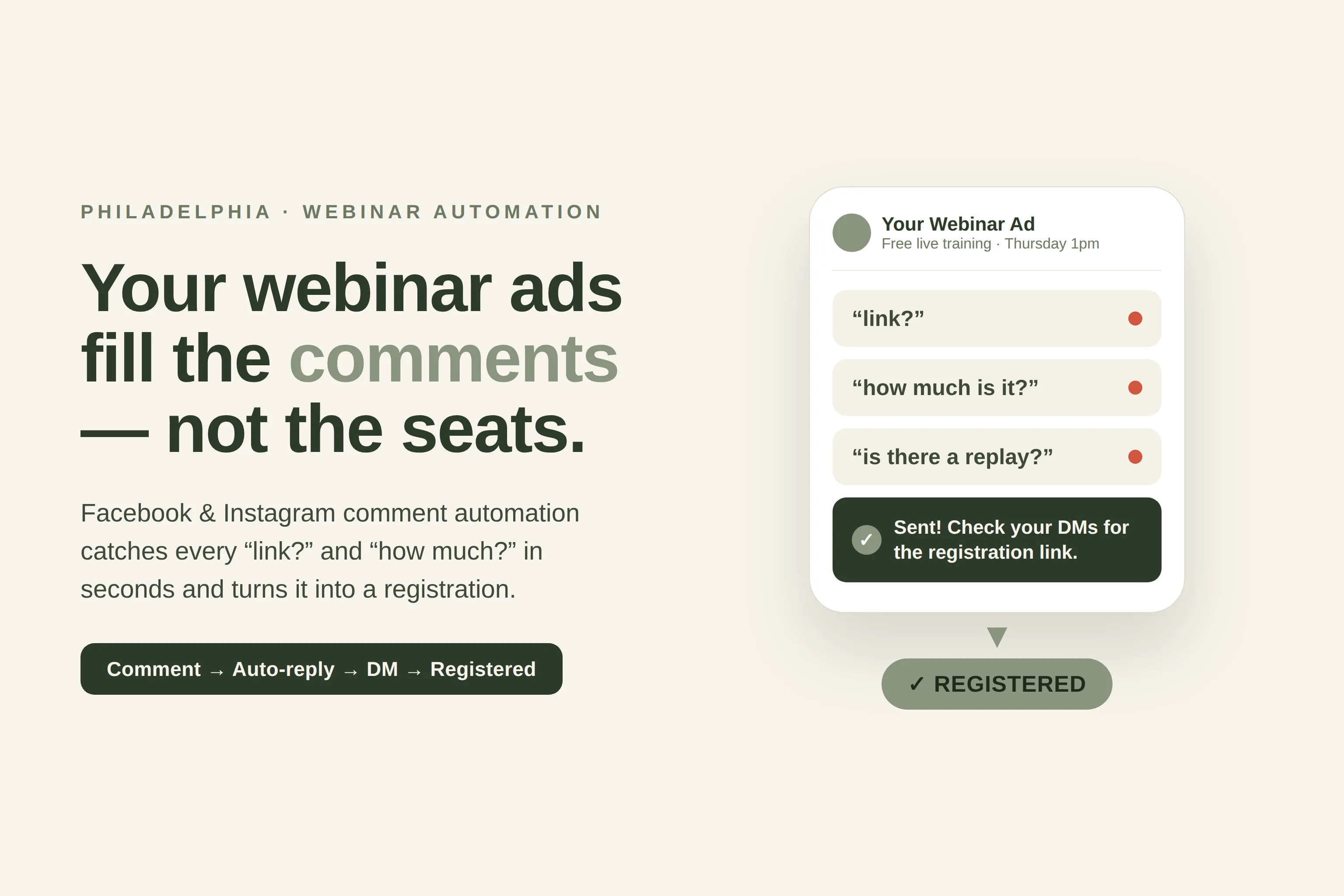
Facebook and Instagram comment automation for webinars is a system that automatically replies to every comment on your posts and ads — the “link?”, “how much?”, and “is there a replay?” questions — and sends each commenter a registration link by DM within seconds, then hands them off to your reminder sequence. For a Philadelphia coach or course creator paying to fill a webinar, it closes the most expensive leak in the funnel: the gap between someone raising their hand in your comments and anyone actually answering them. Most operators never see this leak, because the comments look like engagement. They’re actually unclaimed registrations, cooling by the minute.
The uncomfortable part is the math. You pay for the reach, the click, and the comment — and then a two-day-late reply throws that spend away. This post breaks down exactly where the sign-ups leak, what each cold comment costs, and how comment automation plugs the hole, using real benchmark data rather than vendor hype.
Table of contents
- What is comment automation for webinars?
- The hidden leak: where Philadelphia webinars lose sign-ups
- The 5 comment-stage leaks that quietly kill registrations
- The speed-to-lead math no manual reply can beat
- What a dropped comment actually costs
- How comment automation plugs the leak
- Comment automation vs. manual moderation
- What this means for Philadelphia coaches and course creators
- Do it compliantly
- FAQ
What is comment automation for webinars?
Comment automation is a workflow that watches your Facebook and Instagram posts and ads, detects when someone comments a trigger word or question, replies publicly to keep the thread warm, and — most importantly — sends that person a private message with your webinar registration link, all within seconds and around the clock. From there, the contact drops into your CRM, gets tagged, and enters the same reminder cadence as everyone who registered through your landing page.
Think of it as the missing first mile of your funnel. You already spend on ads and content to earn the comment. Comment automation is what turns that comment into a captured, tagged, reminded registrant instead of a notification you’ll get to “later.” It pairs naturally with Instagram DM automation and a webinar chatbot — the comment is the public doorway; the DM and chat are where the real conversation and qualification happen.
The hidden leak: where Philadelphia webinars lose sign-ups
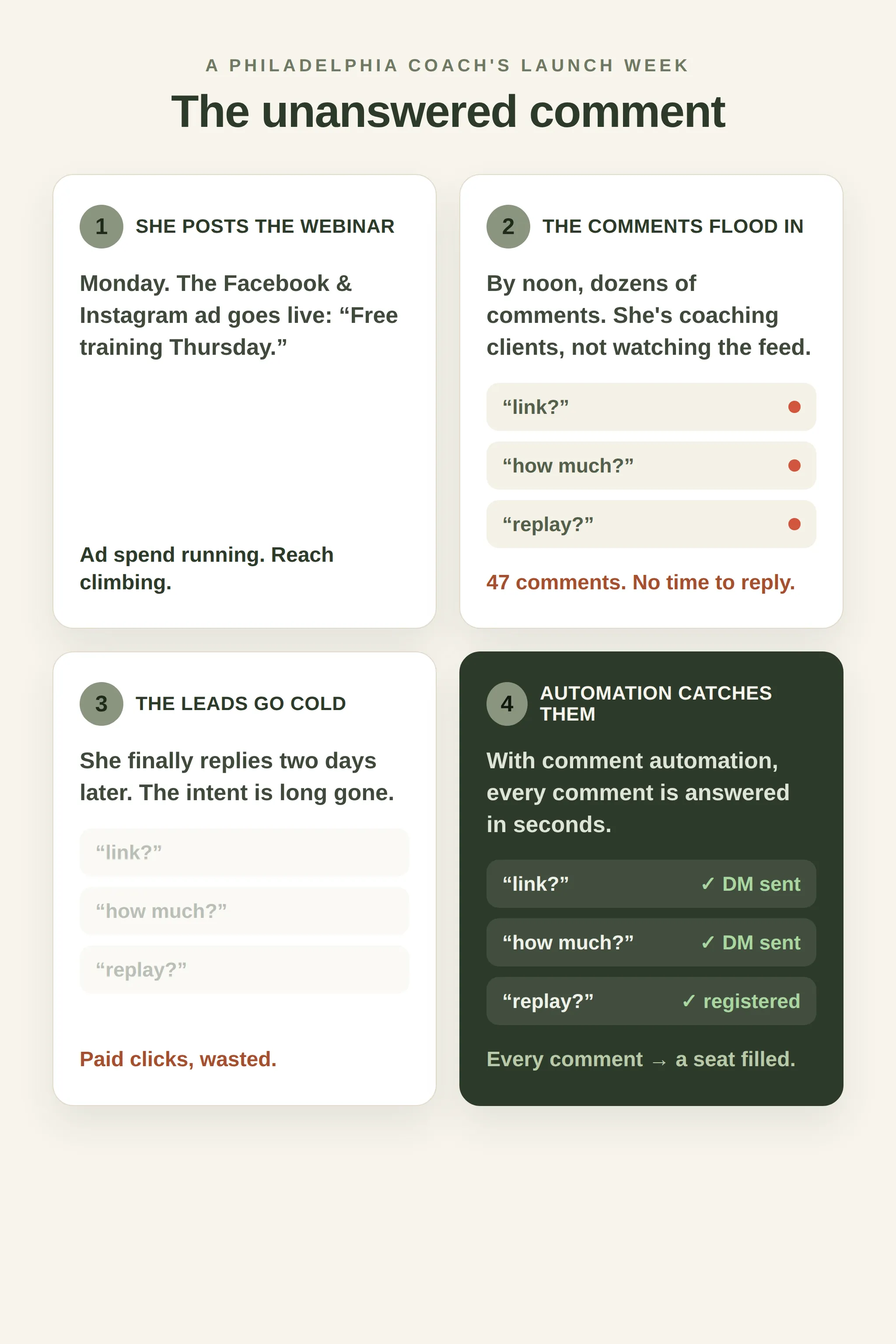
The leak isn’t your landing page or your ad creative — it’s the comment thread underneath the ad, where high-intent people ask to be let in and nobody answers fast enough. A comment like “what time is this?” or “drop the link” is a person who has already done the hard part: they saw the offer, they want in, and they raised their hand in public. That is warmer than a cold click. And it is exactly the moment most operators let slide, because they’re teaching, coaching clients, or asleep.
Here’s the scale of what you’re leaving on the table. Meta reports that more than a billion people message a business every week across its apps, and that roughly 600 million business-to-person chats happen every day on Messenger and Instagram Direct. Messaging is how people now talk to businesses. Yet the expectation and the reality are wildly out of sync: 73% of consumers expect a brand to respond within 24 hours on social (2025 Sprout Social Index), while HBR’s audit of 2,241 companies found the average first response took 42 hours, with 23% of companies never responding at all.
For a webinar, that gap is brutal, because a webinar has a hard start time. A lead who comments on Monday and hears back Wednesday may have already missed Tuesday’s session — or lost the impulse entirely.
The 5 comment-stage leaks that quietly kill registrations
Every one of these looks harmless. Together, they’re why a well-promoted webinar still under-fills.
- The after-hours comment. Your best comments often land at 9 p.m. or on a weekend, when you’re off. By the time you’re back, the moment’s gone. Automation answers at 2 a.m. exactly the way it answers at 2 p.m.
- The buried thread. A post with 40+ comments becomes impossible to triage by hand. You reply to the loud ones and miss the quiet “how do I sign up?” three comments down.
- The public “link?” you answer publicly. Dropping the link in the reply is a small win and a big miss: you have no email, no name, no way to remind them. The click may convert; the contact never enters your system.
- The DM you forget to send. You mean to follow up in DMs, and half the time you don’t. There’s no tag, no task, no trigger — just good intentions.
- The registrant you never remind. Even the comments you do catch rarely get plugged into a no-show recovery sequence, so they register and then evaporate before the session.
Notice the pattern: none of these are failures of intent or effort. They’re failures of timing and plumbing — precisely what automation is built to fix.
The speed-to-lead math no manual reply can beat
The single most under-priced advantage of comment automation is speed. The data on response time is unforgiving, and no human moderating comments by hand can compete with it. The Lead Response Management Study — Professor James Oldroyd’s analysis of InsideSales.com data across more than 15,000 leads and 100,000 call attempts — found that contacting a lead within five minutes rather than thirty made a business about 21× more likely to qualify that lead. Five minutes versus thirty. Now set that against the 42-hour real-world average a manual process produces, and the size of the edge is obvious.
A commenter is in “research mode” the second they type the question — comparing options, deciding whether to spend the hour. Reach them while that intent is live and you’re not selling; you’re just letting them in. Wait, and you’re cold-emailing a stranger who’s forgotten they ever asked. This is the same principle behind fast AI-driven webinar follow-up: the tool wins not because it’s clever, but because it’s there in the seconds that matter.
What a dropped comment actually costs
Because you paid to generate the comment, ignoring it isn’t neutral — it’s a cash write-off. Facebook and Instagram lead generation isn’t free reach; it’s media spend. According to WordStream/LocaliQ’s benchmark analysis, the average Facebook cost per lead is $27.66, the average cost per click on a lead campaign is $1.92, and even a traffic click averages $0.70. Every “what’s the link?” you let go cold is, on average, a lead you already paid roughly $28 to create — deleted.
Run the numbers on a modest campaign. If your ad earns 50 comments in a launch week and you convert the ones you catch at your usual rate, the difference between answering 15 of them by hand and answering all 50 automatically isn’t a rounding error — it’s the difference between a half-full room and a full one. And a fuller room matters all the way down: with average webinar registration-to-attendance rates around 57% (ON24), more registrants is the only reliable way to more attendees, and attendees are who you actually sell.
How comment automation plugs the leak
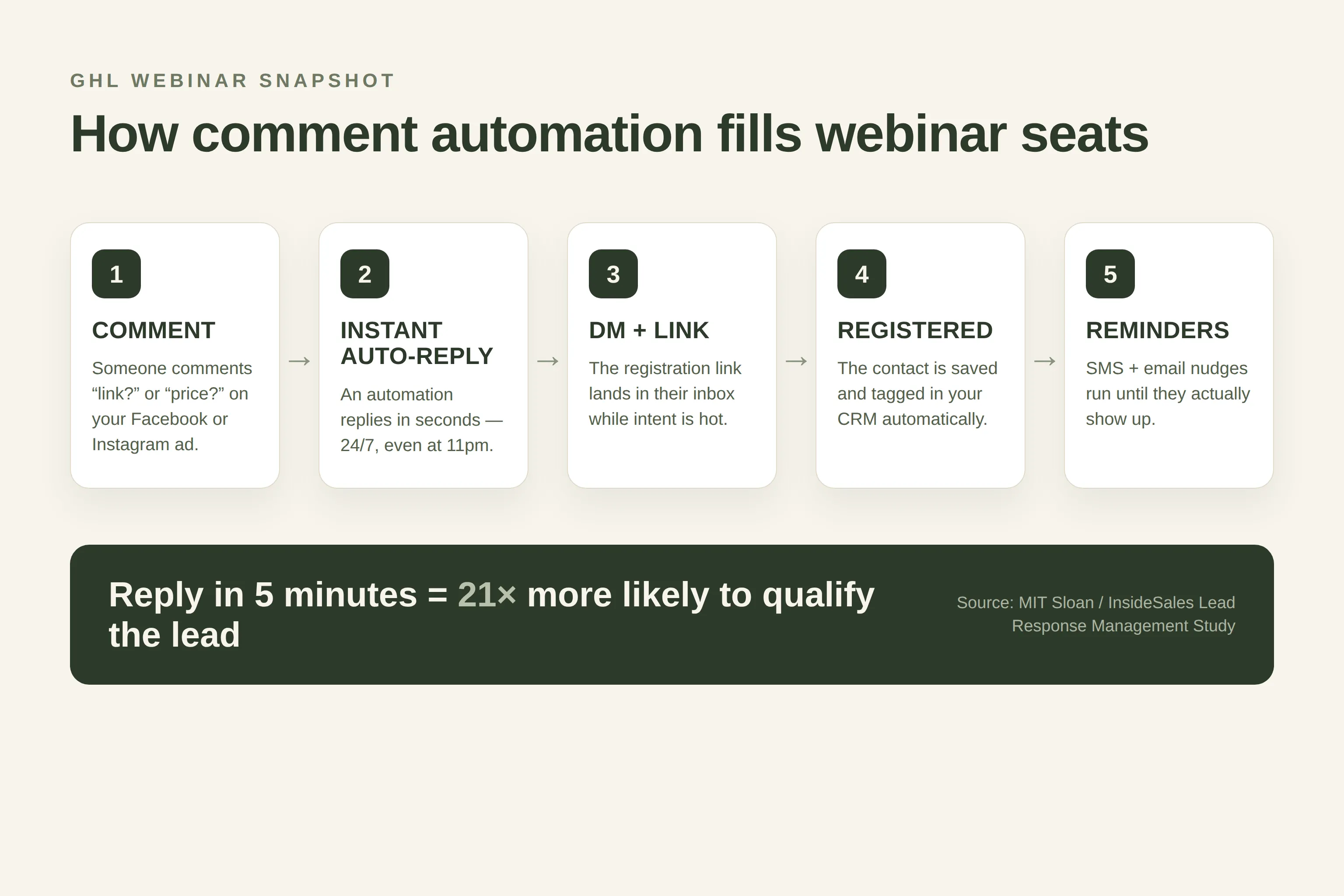
Done right, the flow is invisible to your audience and airtight for you. Here’s the sequence the flow diagram above lays out, step by step:
- Detect. The automation listens for a keyword or question on a specific post or ad — “link,” “join,” “info,” or any phrase you choose.
- Reply publicly. It posts a short, human public reply (“Just sent you the link! 📩”) so the thread stays warm and social proof builds for everyone else reading.
- DM the link. It opens a private message with the registration link — and, because it’s a real conversation, can answer the obvious follow-ups (“is there a replay?”, “is this beginner-friendly?”).
- Capture + tag. The person’s name and contact drop into your CRM, tagged by source (which ad, which post) so your multi-touch attribution stays clean.
- Remind. They enter the same SMS + email reminder cadence as every other registrant, right through to a replay nudge if they miss it.
The important design choice: comment automation shouldn’t be a bolt-on gadget. It should feed the same registration and reminder engine that runs the rest of your funnel, so a lead from the comments is treated exactly like a lead from your landing page — nurtured, scored, and booked. That’s the difference between “we reply to comments now” and “our comments are a registration channel.”
Comment automation vs. manual moderation
You can absolutely reply to comments by hand. The question is what it costs you in speed, coverage, and consistency once volume climbs.
Comment automation vs. replying by hand
| Feature | Comment Automation | Manual Moderation |
|---|---|---|
| Response speed | Seconds, 24/7 | Minutes to days — whenever you're free |
| Coverage at 50+ comments | Every comment, every time | The loud ones; the rest get missed |
| Captures the contact | Yes — name + contact into the CRM | Rarely — you reply and move on |
| Source tagging & attribution | Automatic, per ad/post | Manual, usually skipped |
| Feeds the reminder sequence | Yes — same cadence as all registrants | Only if you remember to add them |
| After-hours & weekends | Fully covered | Not covered |
| Best for | Paid campaigns, launches, high comment volume | A handful of organic comments a week |
Manual moderation is fine when a post gets five comments. The moment you put spend behind it — or a post takes off — hand-replying becomes the bottleneck that quietly caps your registrations.
What this means for Philadelphia coaches and course creators
Philadelphia’s small-business density makes the “answer first” advantage bigger, not smaller. Pennsylvania is home to 1.2 million small businesses, 99.6% of all businesses in the state (SBA Office of Advocacy, 2025). From Center City consultants to Main Line coaches to the Fishtown creator scene, a lot of people are running webinars to the same regional audience — and increasingly the same national one. When several of them are advertising similar free trainings, the operator whose comments get answered in seconds is the one whose room fills.
There’s a local-search angle too. As buyers ask AI assistants and search for “[webinar]/[coaching] near me in Philadelphia,” the businesses that respond fast and capture contacts build the review volume and engagement signals that feed local SEO and AI search. Speed at the comment stage isn’t just a conversion tactic; it compounds into visibility.
If you’re weighing whether to run this yourself or have it built and managed, that’s the same do-it-yourself vs. done-for-you social media decision every busy operator faces. The setup — connecting Meta, mapping keywords, wiring the DM-to-CRM handoff, and keeping it compliant — is a few hours of specialist work that then runs for every campaign you launch after.
Do it compliantly
Automation that touches DMs and SMS lives inside real rules — treat them as a first-class concern, not an afterthought.
- Meta’s platform rules. Comment-to-DM automation is permitted, but Messenger and Instagram messaging operate inside Meta’s policies and messaging windows. Keep replies genuinely useful, honor opt-outs, and don’t use automation to spam or evade limits.
- SMS / TCPA / A2P 10DLC. The moment a captured lead flows into text reminders, U.S. SMS rules apply: get clear consent, identify yourself, and include opt-out (“Reply STOP”) on the qualifying message. Our SMS compliance guide covers the specifics.
- Say what’s true. Keep public replies and DMs honest about what the webinar is and isn’t. No fake scarcity, no guarantees.
None of this is a reason to avoid automation — it’s a reason to have it built properly the first time, so the plumbing is compliant by design.
Related posts
- Instagram DM Automation for Webinars
- The Webinar Chatbot Playbook
- Webinar No-Show Recovery
- DIY vs. Done-for-You Social Media
- Facebook Ads for Webinars
FAQ
Facebook & Instagram comment automation — FAQ
What is Facebook and Instagram comment automation for webinars?
It's an automated workflow that detects when someone comments a keyword or question on your post or ad, replies publicly to keep the thread warm, and privately DMs them your webinar registration link within seconds — then captures the contact in your CRM and enrolls them in your reminder sequence. It turns comments from vanity engagement into an actual registration channel.
Is comment automation against Facebook or Instagram's rules?
No — comment-to-DM automation is a supported use case, but it operates inside Meta's Messenger and Instagram platform policies and messaging windows. The key is to keep replies genuinely helpful, honor opt-outs, and avoid spammy or manipulative behavior. Built correctly, it's fully within the rules.
How is this different from a chatbot or DM automation?
A chatbot lives on your website and answers visitors who are already there. DM automation handles private messages people send you. Comment automation is the public front door: it catches the person commenting on your post or ad — often your warmest, highest-intent traffic — and pulls them into that DM conversation automatically.
Will automated replies feel spammy to my audience?
Not if they're written well. The goal is a short, human public reply and a helpful DM that answers a real question and hands over a link. Because the person literally asked for it in the comments, a fast, useful reply reads as good service — the opposite of spam. The spammy version is the one that never comes and forces them to hunt for the link.
Do I need a big ad budget for this to be worth it?
No. It pays off any time you're generating comments — paid or organic. Since the average Facebook cost per lead is around $27.66, even a small budget makes catching every commenter worthwhile. And on organic posts that take off, automation is the only way to answer 50+ comments without living in your notifications.
Can GoHighLevel run comment automation, or do I need another tool?
The comment-detection and DM layer is triggered through Meta's tools or a comment-automation app, and GoHighLevel runs the engine underneath — capturing the contact, tagging the source, and driving the SMS + email reminder cadence. Our done-for-you social media service wires the two together so a lead from your comments is treated exactly like one from your landing page.
Written by Priya Shankar, Course Launch & Conversion Coach. Priya works with course creators and founders who teach to sell — masterclasses, demos, and high-ticket coaching webinars — and writes about connecting the human side of a live event to the systems that capture, nurture, and book the people most ready to buy. Personas are illustrative and used for editorial attribution; nothing here is an income or attendance guarantee.