
You open the ON24 site to do one simple thing: find out what it costs. You click “Pricing” and hit a wall. No tiers. No starting number. Just a form and a “Request pricing” button. Forty minutes later you’re on a discovery call with a rep who wants your “annual webinar volume” before anyone will say a dollar amount out loud.
That’s not an accident. It’s the pricing model.
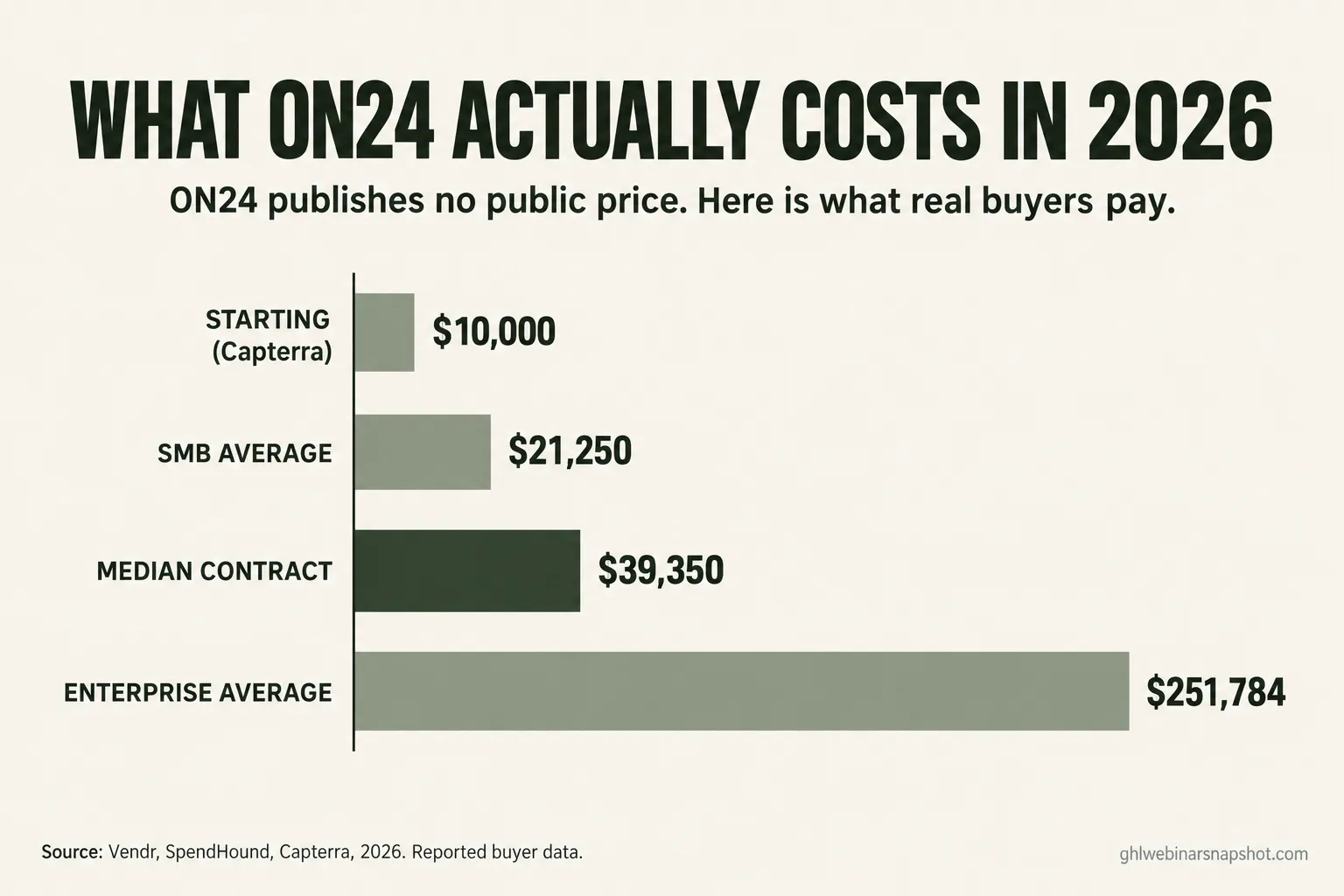
Here’s the short answer: most organizations pay ON24 between $25,000 and $100,000 a year, the median contract lands around $39,350 annually based on 96 verified purchases, and that number excludes the $5,000 to $25,000 in setup fees, the per-module add-ons, and the annual contract you can’t exit mid-term. For a solo coach or small team, ON24 is priced for someone else. For a mid-size or enterprise B2B shop it can be worth it, but only once you know the real total and have forced a written quote. This teardown walks the numbers, the four buried costs, three honest budgets, and the script to make a rep give you a figure on the first call.
Table of contents
- What does ON24 actually cost in 2026?
- Why won’t ON24 show you a price?
- The real numbers, from people who actually bought it
- The four costs that never show up in the quote
- ON24 priced for three real buyers
- How to force a real number out of the sales team
- ON24 vs the transparent alternatives
- The compliance line item nobody quotes
- Common objections, answered
- FAQ
What does ON24 actually cost in 2026?
ON24 is enterprise webinar software, genuinely good at what it does: large audiences, polished console, deep analytics, Salesforce and Marketo integrations. It is also expensive, and it hides the number on purpose. Here’s what real purchases say you’ll pay.
The median is nearly forty thousand a year, the range is wide because ON24 prices on event volume and audience size, the setup fee is a separate up-front line, and there’s no way to swipe a card and start. If you run a handful of webinars a year to a few hundred people, that median should stop you cold. This is priced for a marketing team with a budget line, not a solo operator selling a course. If that’s you, skip to the alternatives. Mid-size or enterprise buyer? Keep reading, because the real cost runs higher than that median once the add-ons land.
Why won’t ON24 show you a price?
Three reasons, and understanding them is how you negotiate.
First, price discrimination. When the number is public, everyone pays the same. Quoted per-deal, the rep can charge a 500-person startup one figure and a Fortune 500 another for identical software. Hiding the price lets ON24 read your company size, urgency, and budget before naming a number. The quote is tuned to you, not the product.
Second, the bundle is deliberately fuzzy. ON24 sells a core webinar product plus modules: engagement hub, content library, analytics tiers, integration packages. A public price would force them to itemize. A custom quote lets them bundle so you can’t see what each piece costs.
Third, it signals “enterprise.” A posted $49/month price says “self-serve, figure it out yourself.” A “request a demo” wall says “serious software with an account team.” For the customer ON24 wants, opacity is a feature, not a bug.
Here’s how deep the fog goes: the review sites that cover ON24 can’t even agree on what its tiers are called. Some list them as Essentials, Standard, and Advanced. Others report Professional, Enterprise, and Elite. Same vendor. When the aggregators who do this for a living can’t pin down the tier names, that’s not a research gap. That’s a company making sure nobody outside a sales call knows the menu.
The real numbers, from people who actually bought it
Because ON24 won’t talk, the useful data comes from procurement platforms that track what their clients actually paid. Treat every figure as reported third-party data, not an official rate card, because none exists.
- Vendr (software buying platform): median ON24 contract around $39,350/year across 96 tracked purchases, buyers saving ~17% off the first quote. Most land in the $25,000 to $100,000+ band.
- SpendHound: average SMB spend near $21,250/year, average enterprise spend near $251,784/year. That gap is the whole story. ON24 scales its price hard with company size.
- Capterra lists a typical starting figure around $10,000/year and confirms no free version and no free trial. That $10k floor is one almost nobody lands on once events and modules are counted.
The shape is clear: small shops pay low five figures, typical buyers high five figures, big enterprises into six.
The four costs that never show up in the quote
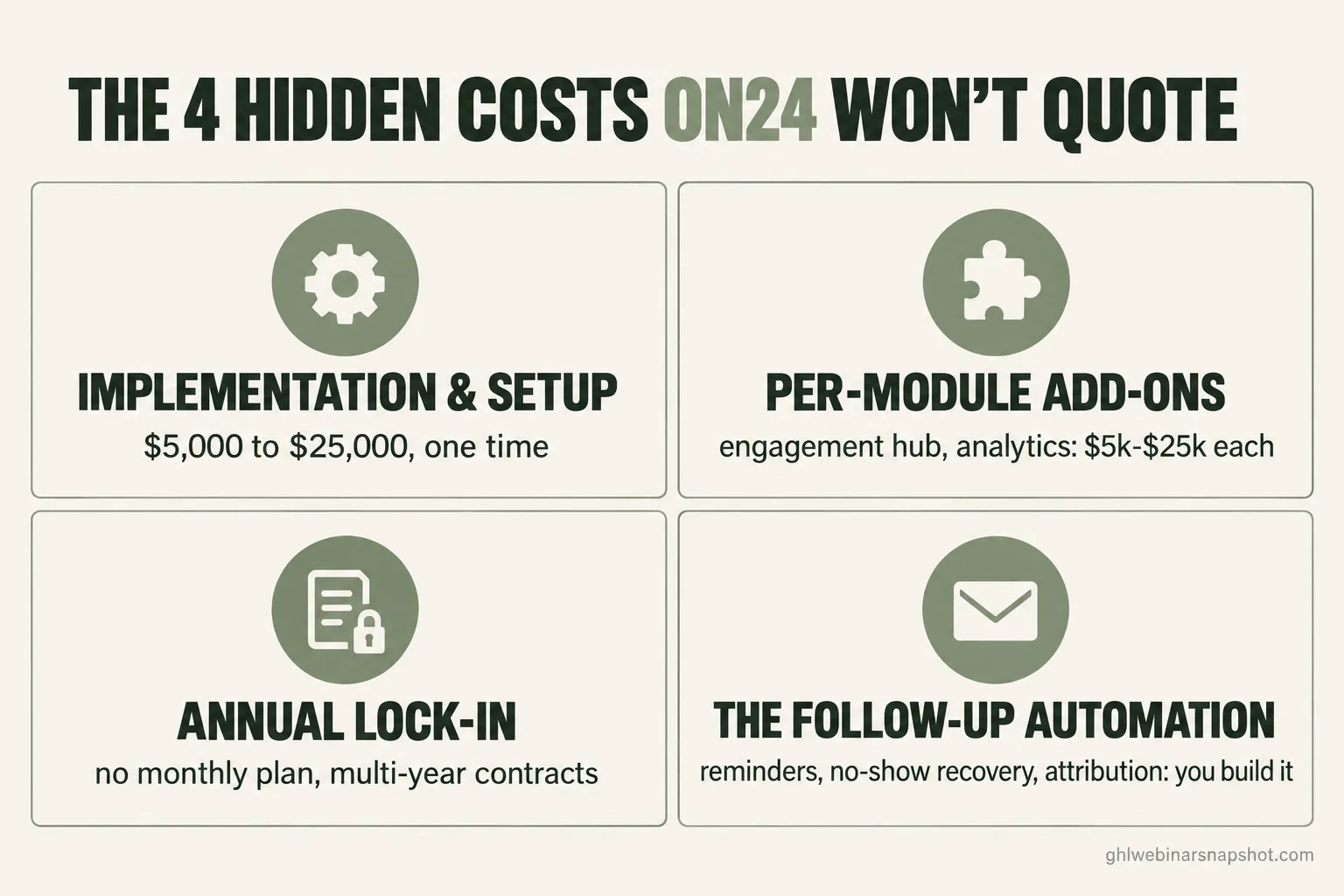
Even once you have a contract number, four costs sit outside it. Miss them and your real first-year spend runs 30% to 60% over the figure the rep quoted.
1. Implementation and professional services
ON24 is not a tool you turn on. Standing up the console, wiring your CRM and marketing automation, building templates, and training the team is a project, and ON24 charges for it. Reported onboarding and professional-services fees run $5,000 to $25,000, paid once, up front, on top of the license.
How it breaks: teams budget the license and forget the setup line, so the first invoice lands thousands over plan. Skip paid onboarding to save money and you under-use the platform, analytics stay shallow, and at renewal you can’t prove ROI. Put the implementation fee in your year-one budget before you sign, in writing.
2. Per-module add-ons
The base license is the start. The pieces that make ON24 “ON24” (engagement hub, content library, advanced analytics, extra integrations) are frequently separate line items, each reported at $5,000 to $25,000. A quote that looks like $30k becomes $55k once the two modules you need are added.
How it breaks: the rep demos the full platform, you fall for the hub and the analytics, then the quote arrives with those as upgrades. Decide which modules you need before the demo, not during it, so you’re not negotiating against your own excitement.
3. The annual lock-in
There is no monthly plan. ON24 sells annual, often multi-year, contracts. If your program changes in month three (new strategy, budget cut, a pivot away from big live events) you’re still paying through the term.
How it breaks: a team signs a two-year deal on an optimistic forecast, runs half the webinars they planned, and pays year two full freight for a tool they barely touch. If volume is uncertain, negotiate a one-year term even at a higher rate, and lock renewal pricing in writing.
4. The automation ON24 doesn’t build for you
This is the cost nobody quotes, on any platform. ON24 fills the room and tracks the room. It does not build your reminder cadence, no-show recovery, lead scoring, attribution to closed pipeline, or one-click call booking. That connective tissue, the part that turns a webinar into revenue, is yours whatever you host on.
How it breaks: teams assume an expensive platform includes the follow-up system. It doesn’t. The webinar runs and the leads sit in a spreadsheet because nobody built the sequence that texts the no-shows and books the hot ones. That’s 40-plus hours of automation work on top of your license fee, the same whether you pay ON24 forty grand or run a leaner stack, and it’s where most of the money is won or lost. Our conversion funnel breakdown shows which automation plugs each stage.
ON24 priced for three real buyers
The same software and the same opaque quote produce wildly different value by buyer.
The solo coach or course seller ($2k-$50k/month)
Two to six webinars a quarter, audiences of 100 to 500. Your real need is show-up rate, clean follow-up, and booked calls.
ON24 verdict: wrong tool, wrong price. A $25k+ floor plus a five-figure setup fee, against a program earning low-to-mid five figures per launch, is upside down. A transparent tool in the $49-$199/month range plus a real follow-up layer does your job for a fraction of the spend. See our best webinar software for coaches short list.
The mid-size B2B team (20-200 people)
A monthly webinar program for pipeline, audiences of 300 to 1,000, Salesforce or HubSpot integration, and attribution RevOps trusts.
ON24 verdict: plausible, if you negotiate. You’re the buyer ON24 is built for, and the median ~$39k contract is in range if webinars are a core channel. Force an itemized quote, push for the ~17% buyers typically negotiate off, and insist on a one-year term the first time. The bigger risk isn’t the license, it’s assuming ON24’s analytics equal attribution. They track engagement; tying that to closed revenue in your CRM is still a build. Read how to attribute registrants to pipeline before you decide the platform solves it.
The enterprise marketing org (200+ people)
Dozens of webinars and virtual events a year, multiple presenters, big audiences, strict security review, and you want the hub, content library, and deep analytics.
ON24 verdict: this is who it’s for. At this scale the six-figure average can pencil out, because the alternative is stitching several tools together with headcount that costs more. Your job is procurement discipline: multi-year only if the discount is real, renewal caps in writing, every module justified by a use case, and a named owner for the automation layer ON24 won’t build.
Affiliate disclosure: the GoHighLevel link above is an affiliate link. If you start a plan through it we may earn a commission, at no extra cost to you. We only recommend it because it’s the platform our own webinar automation runs on.
How to force a real number out of the sales team
You can’t avoid the sales call, so make it efficient. The goal: walk out of the first conversation with a written, itemized figure, not three more meetings. Steal this.
If a rep still won’t give you a number, treat it as information. A vendor that won’t quote a buyer ready to decide is betting you’ll lose your leverage in a slow cycle. Walk.
ON24 vs the transparent alternatives
For most buyers the real choice is an opaque enterprise contract versus a transparent tool plus your own automation layer.
| Feature | ON24 | Transparent stack (e.g. GoTo/Demio + automation) |
|---|---|---|
| Public price | None; quote only | Published, pay in minutes |
| Typical annual cost | ~$39,350 median; $25k-$100k+ | ~$600-$5,000 platform, plus build |
| Setup / implementation fee | $5,000-$25,000 one-time | $0 self-serve; your time to configure |
| Contract | Annual / multi-year lock-in | Monthly or annual, cancel anytime |
| Free trial | None | Common across tools |
| Best fit | Enterprise, high event volume | Solo, SMB, and most mid-size teams |
| Follow-up automation included | No, you build it | No, you build it (same work) |
A few notes on the transparent side:
- Demio starts around $49/month ($42 annual) for 50 attendees and one host, scaling with room size and presenters. Clean for coaches and small teams.
- GoTo Webinar publishes four tiers from $49/month (250) to $399/month (3,000), billed annually. The most ON24-adjacent tool that still shows its price.
- BigMarker, ON24’s closest hidden-price rival, quote-gates its enterprise tier but publishes self-serve plans from ~$29/month, with a reported median contract around $9,690/year. Cheaper than ON24 at the top, still opaque.
Every one of these, ON24 included, leaves the revenue automation to you. That’s the equalizer. Once you accept that the reminder cadence, no-show recovery, scoring, attribution, and booking flow are a build no matter what you host on, the platform becomes a commodity, and the question gets simple: how much do you want to pay for the room? For a line-by-line on every vendor, see our full webinar software pricing teardown.
The compliance line item nobody quotes
The reminder sequence that lifts your show-up rate is regulated, whatever you pay for the platform. SMS reminders in the US fall under the TCPA and require A2P 10DLC registration with documented consent before you send. Email reminders fall under CAN-SPAM: a real unsubscribe path and accurate headers. Record attendee audio or video and two-party consent states like California and Florida add their own rules. ON24 handles none of this, and neither does any other platform. It’s your campaign, your consent records, your liability. Our SMS compliance guide covers the consent language.
Common objections, answered
“ON24 is the enterprise standard. Doesn’t the price just reflect that?” Partly. At true enterprise scale, with heavy volume and the full module stack, ON24 earns its keep and the six-figure average can beat the headcount to run a stitched-together alternative. Below that scale the objection falls apart. A solo coach or small team is paying enterprise prices for capacity they’ll never fill. “Standard” is only a reason to buy if you’re the size it was written for.
“We already run Salesforce and Marketo. Doesn’t ON24 integrate better than anything else?” It integrates well, a real point for RevOps-heavy teams. But “integrates with your CRM” is not “builds your attribution and follow-up.” ON24 passes engagement data into Salesforce; turning that into a scored pipeline, a booked-call flow, and closed-revenue attribution is still a build you own. ON24 does the room job, not the automation job.
“Isn’t the quote process just normal for enterprise software?” It’s common, not harmless. Opaque pricing exists to maximize what each buyer pays and slow you down until you’re invested in the sales cycle. Counter it the same way every time: a hard budget, a decision date, named competitors, and an itemized quote in writing. Treat the opacity as a negotiation you’re already in, because you are.
FAQ
ON24 pricing questions, answered
How much does ON24 cost per year?
There's no public price. Verified third-party purchase data puts the median ON24 contract around $39,350/year, with most buyers paying $25,000 to $100,000+. SMBs average near $21,250/year and large enterprises far more. Add $5,000-$25,000 in one-time implementation fees on top.
Does ON24 have a free trial or a monthly plan?
No. ON24 has no standard free trial and no self-serve monthly plan. It sells annual or multi-year contracts, custom-quoted by sales, so you can't sign up and start on your own the way you can with Demio, GoTo, or BigMarker's lower tiers.
Why doesn't ON24 publish its pricing?
It lets them quote each buyer a different price by company size and budget, keeps the module bundle fuzzy so you can't itemize what each piece costs, and signals 'enterprise software with an account team.' The opacity is intentional and part of the negotiation.
What are ON24's hidden costs?
Four: one-time implementation and professional services ($5k-$25k), per-module add-ons like the engagement hub and advanced analytics ($5k-$25k each), the annual or multi-year lock-in with no monthly option, and the follow-up automation (reminders, no-show recovery, scoring, attribution, booking) ON24 doesn't build on any plan.
Is ON24 worth it for a small business or solo coach?
Usually not. The $25k+ floor plus a five-figure setup fee is upside down against a program earning low-to-mid five figures per launch. Transparent tools in the $49-$199/month range, plus your own automation layer, do the same job for a fraction of the cost. ON24 makes sense at mid-size and enterprise scale with real event volume.
What are the best ON24 alternatives in 2026?
For most buyers: GoTo Webinar (transparent, $49-$399/mo), Demio ($49/mo and up, great for coaches), and BigMarker (self-serve from ~$29/mo, enterprise still quote-gated). None include the revenue automation, so budget to build the reminder, follow-up, and attribution layer whichever you pick.
ON24 is good software with a pricing strategy built to keep you from knowing what good software should cost. The number isn’t secret because it’s special. It’s secret because secrecy pays. Now you know the real figure, the costs they bury, and the script to drag a quote into daylight. Whichever way you go, remember the room is only half the system. The follow-up is where the money lives, and that part is yours to build no matter who you pay for the stream.