
You go looking for BigMarker’s price and the internet lies to you in two directions at once. Old roundups still show tidy self-serve tiers, twenty-nine dollars here, ninety-nine there, like BigMarker is the friendly browser-based webinar tool it was five years ago. Then you hit the real site, click “Request a demo,” and a rep wants your “annual event volume” before anyone names a dollar. The cheap tiers are mostly ghosts. The quote is real, and it is bigger than you think.
That gap is the whole story. BigMarker quietly became a demo-gated virtual-events platform and left the old price tags lying around to confuse you.
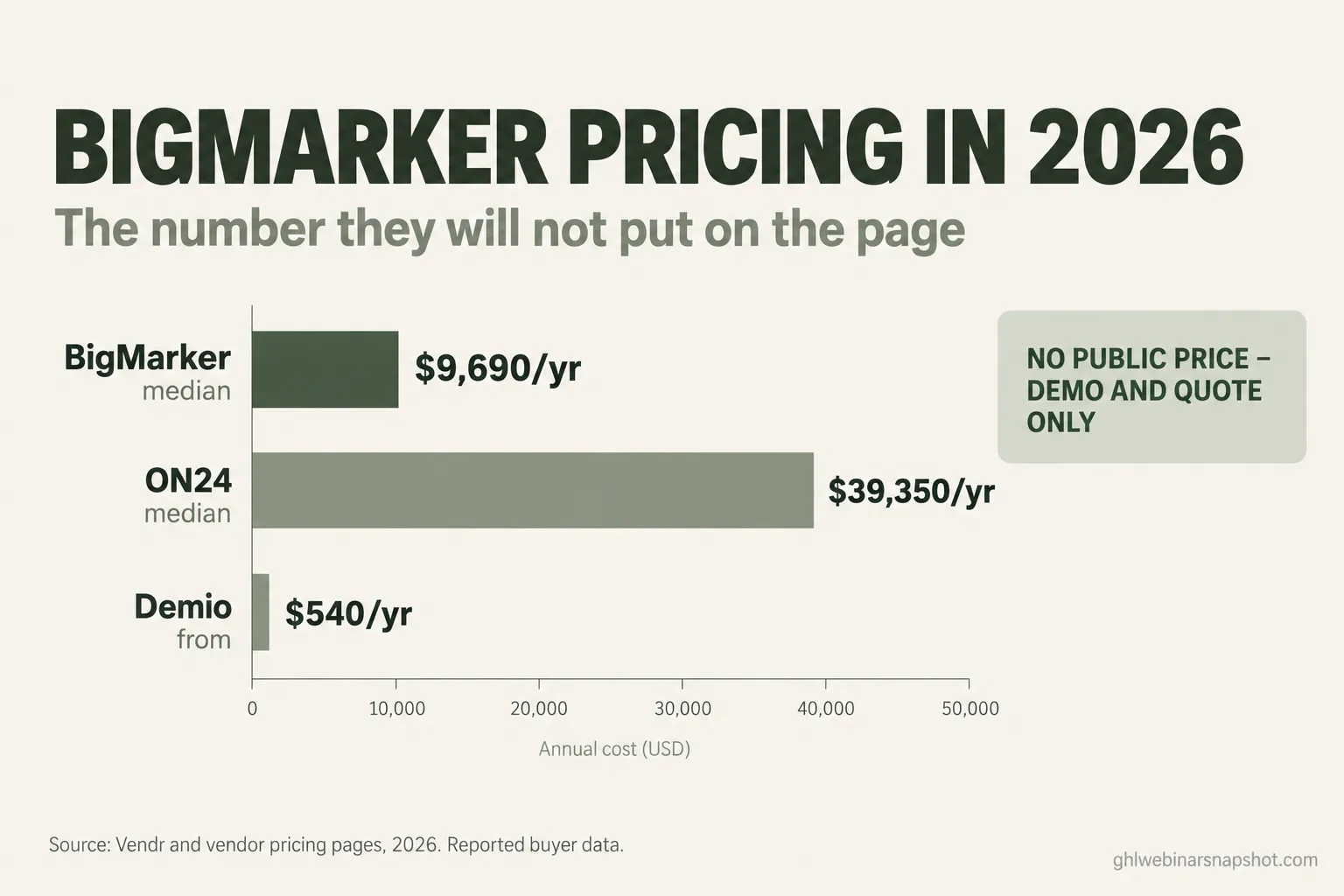
Here’s the short answer: most organizations pay BigMarker a median of around $9,690 a year, with real contracts commonly running from the low four figures up past $30,000, sold as a contract rather than a monthly subscription, metered by attendees and events, and quoted only after a sales call. For a solo coach it is almost always more platform than the job needs. For a mid-size team running a real webinar program, or anyone building a multi-session summit, it can be a fair deal, but only once you know the true total and have forced a written quote. This teardown walks the numbers, the four costs the quote leaves out, three honest budgets, and the script that drags a figure into daylight on the first call.
Table of contents
- What does BigMarker actually cost in 2026?
- What happened to BigMarker’s self-serve plans?
- The real numbers, from buyers who signed
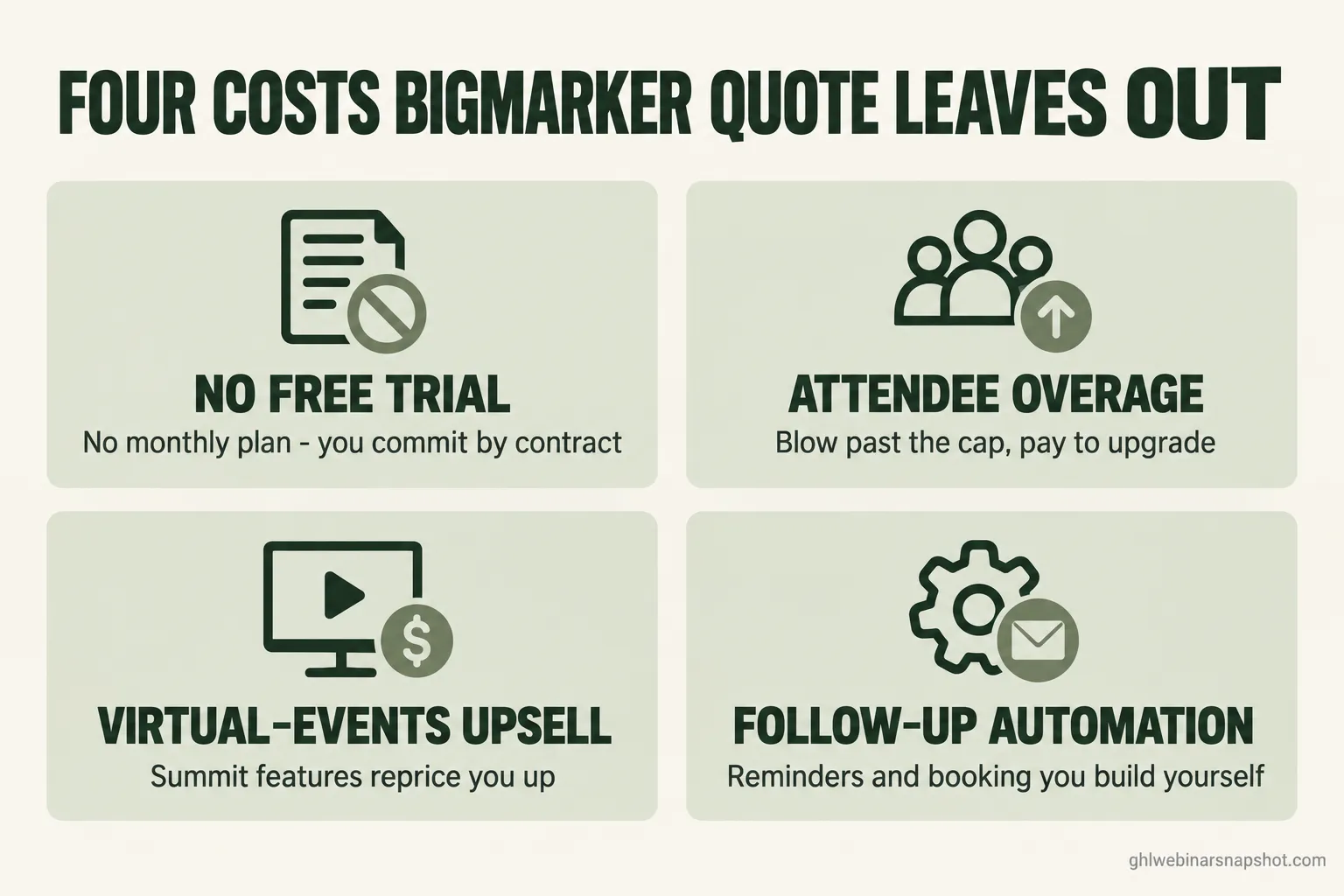
- Four costs the quote leaves out
- BigMarker priced for three real buyers
- How to get a real quote on the first call
- BigMarker vs the tools that show their price
- The compliance bill nobody line-items
- Objections, answered
- FAQ
What does BigMarker actually cost in 2026?
BigMarker is a capable platform: live, automated, and on-demand webinars in the browser with nothing to download, streaming to YouTube and Facebook Live, scaling up into full virtual summits. It is also priced the way opaque software is always priced: by a rep, after a call, tuned to what they think you will pay.
That median is far below ON24’s roughly $39,350, which is exactly how BigMarker positions itself: the capable platform that undercuts the enterprise giant. But it is nowhere near the sub-$100-a-month impression the old tier tables leave you with.
What happened to BigMarker’s self-serve plans?
BigMarker launched as an approachable, browser-based webinar tool and for years published self-serve plans you could read and buy without talking to anyone. Those legacy tiers, often reported as a Starter around $29 to $39 a month, a middle plan near $99, and higher tiers at $199 and up, still populate directory sites, affiliate roundups, and half-updated “best webinar software” lists. Treat every one of those figures as a historical artifact, not a current rate card.
Over the last few years BigMarker chased the bigger money: virtual events, summits, and hybrid conferences, where a single contract dwarfs a creator’s monthly subscription. As it moved upmarket, it pulled the prices off the page and put a “Request a demo” button where the pricing table used to be. The product got more powerful and the buying process more opaque. Today the plans are reported as Basic, Professional, and Enterprise (with white-label branding and API access reserved for Enterprise), and not one carries a public number.
Why hide a number it used to show? Opacity lets a rep quote each buyer differently by size and budget, keeps the line between “webinars” and the pricier “events” package blurry, and signals an enterprise platform rather than a self-serve tool. For the buyers BigMarker now wants, that is a feature.
The real numbers, from buyers who signed
Because BigMarker won’t talk price publicly, the useful data comes from procurement and review platforms that track what buyers actually paid. Treat every figure as reported third-party data, not a rate card.
- Vendr (software-buying platform): a median BigMarker contract around $9,690/year, the most reliable anchor you have because it reflects real negotiated deals.
- Review aggregators like G2, Capterra, and TrustRadius confirm the two facts that matter: pricing is quote-based, and there is no standard free trial, only a guided demo.
- The event tier is a different animal. Contracts that include virtual-summit and hybrid-event features are reported well above the webinar median, because you are now paying for a conference platform, not a webinar room.
The shape is clear: a light webinar user who negotiates lands in the low-to-mid four figures a year, a typical buyer sits near ten thousand, and an events or summit buyer climbs into the mid-five figures and keeps going.
Four costs the quote leaves out
Even once you have a contract figure, four costs sit outside it, and they push your real first-year spend well over the number the rep first said.
1. No free trial, no monthly off-ramp
There is no self-serve monthly plan and no free trial. You cannot swipe a card, run one webinar, and bail. You commit through a demo and a contract before hosting a single event, and the reported median is a per-year figure, so you are planning around a term, not a month.
How it breaks: a team commits on an optimistic forecast, runs half the webinars they planned, and pays full freight for a tool they barely touch. If your volume is uncertain, negotiate the shortest term the rep allows, or start on a transparent monthly tool first.
2. The attendee meter and its overage
BigMarker prices on peak concurrent live attendees. The plan that fits a 200-person room is not the plan that fits the 600-person room your best webinar pulls. Blow past the cap and you are cut off at the ceiling or pushed to upgrade mid-term.
How it breaks: operators size the plan to their average webinar, then one breakout event hits the cap, locks people out, or triggers an upgrade. Size to your realistic best case, not your median, and get the overage rule in writing first.
3. The virtual-events upsell
This is the big one, and the reason BigMarker hides prices. The webinar features might land near that $9,690 median, but the moment you want a multi-session summit, sponsor booths, networking, or a branded hub, you are quoted the events tier, a different and much larger number.
How it breaks: the demo shows you the full summit experience, you fall for the booths and the agenda builder, and the quote arrives priced as an event platform. Decide before the demo whether you are buying a webinar tool or a conference tool, and make the rep quote only what you need.
4. The automation BigMarker doesn’t build for you
This is the cost nobody quotes, on any platform. BigMarker fills the room and streams the room. It does not build your reminder cadence, no-show recovery, lead scoring, attribution to closed pipeline, or one-click call booking. That connective tissue, the part that turns a webinar into revenue, is yours whatever you host on.
How it breaks: teams assume a four-or-five-figure platform includes the follow-up system. It doesn’t. The webinar runs and the leads sit in a spreadsheet because nobody built the sequence that texts the no-shows and books the hot ones. That is 40-plus hours of automation work on top of your license, the same whether you pay BigMarker ten grand or run a leaner stack. Our conversion funnel breakdown shows which automation plugs each leak.
BigMarker priced for three real buyers
The same platform and the same opaque quote produce very different value depending on who is buying.
The solo coach or course seller ($2k-$50k/month)
Two to six webinars a quarter, audiences of 100 to 500. Your real need is show-up rate, clean follow-up, and booked calls, not a summit platform.
BigMarker verdict: usually more than you need. A four-figure commitment with no monthly option, against a program earning low-to-mid five figures per launch, is a lot of fixed cost for a webinar room. A transparent tool at $45 to $99 a month plus a real follow-up layer does the job for a fraction of the spend and lets you quit any time. See our best webinar software for coaches list first.
The mid-size B2B team (20-200 people)
A monthly webinar program for pipeline, audiences of 300 to 1,000, a CRM to integrate, and attribution RevOps trusts.
BigMarker verdict: plausible, if you negotiate. You are close to the buyer BigMarker wants, and the ~$9,690 median is in range if webinars are a core channel. Force an itemized quote, push on the attendee cap and overage, and refuse the events tier if you only run single-session webinars. The bigger trap is assuming BigMarker’s analytics equal attribution. They track engagement; tying that to closed revenue in your CRM is still a build. Read how to attribute registrants to pipeline first.
The virtual-events or summit organizer
Multi-session summits, multiple speakers, sponsor booths, networking, big audiences, a branded hub. This is the tier BigMarker built the pivot around.
BigMarker verdict: this is who it’s for. At event scale the higher number can pencil out, because the alternative is stitching several tools together with headcount that costs more. Your job is procurement discipline: an itemized quote that separates the events platform from the webinar base, a written overage policy, renewal pricing locked now, and a named owner for the follow-up automation. The platform runs the conference. It does not run the revenue.
Affiliate disclosure: the GoHighLevel link above is an affiliate link. If you start a plan through it we may earn a commission, at no extra cost to you. We only recommend it because it is the platform our own webinar automation runs on.
How to get a real quote on the first call
You can’t dodge the sales call, so make it count. Leave it with a written, itemized figure, not three more meetings. Steal this.
If a rep still won’t give you a number, treat that as information. A vendor that won’t quote a buyer ready to decide is betting you’ll lose your edge in a slow cycle. Walk.
BigMarker vs the tools that show their price
For most buyers the real choice is a demo-gated contract versus a transparent tool plus your own automation layer. Here is how BigMarker stacks against the platforms that still publish a number.
| Feature | BigMarker | Transparent tools (Demio / eWebinar / Livestorm) |
|---|---|---|
| Public price | None; demo + quote only | Published, buy in minutes |
| Typical cost | ~$9,690/yr median; $3k-$30k+ | ~$45-$300/mo depending on tool + size |
| Billing | Contract, sold per year | Monthly or annual, cancel anytime |
| Free trial | None; guided demo | Common across all three |
| Scales to full virtual events | Yes, at the events tier | Limited; webinars first |
| Best fit | Events, summits, bigger B2B programs | Solo, SMB, and most mid-size teams |
| Follow-up automation included | No, you build it | No, you build it (same work) |
A few notes on the transparent side, so you can sanity-check any quote:
- Demio starts at $45/month billed annually (about $63 month-to-month) for 50 attendees and one host, with Growth and Premium tiers priced per host and scaled by audience size. Clean and modern, great for coaches and small teams.
- eWebinar publishes three tiers at $99, $199, and $299/month, priced by active automated webinars and monthly registrants. Built for evergreen, automated webinars.
- Livestorm sells a Pro plan metered by attendee credits (you pay per person who actually attends) with a per-event cap and a four-hour live limit, then custom Business and Enterprise quotes.
- ON24, BigMarker’s closest hidden-price cousin, also quote-gates everything and runs far higher, a ~$39,350 median.
Every one of these, BigMarker included, leaves the revenue automation to you. Once you accept that the reminder cadence, no-show recovery, scoring, attribution, and booking flow are a build no matter what you host on, the platform becomes a commodity, and the question gets simple: how much do you want to pay for the room? For a line-by-line on every vendor, see our full webinar software pricing teardown.
The compliance bill nobody line-items
The reminder sequence that lifts your show-up rate is regulated, whatever you pay for the platform. SMS reminders in the US fall under the TCPA and require A2P 10DLC registration with documented consent before you send. Email reminders fall under CAN-SPAM: a working unsubscribe path and honest headers. Record attendee audio or video and two-party-consent states like California and Florida add their own rules. BigMarker handles none of this, and neither does any other platform. It is your campaign, your consent records, your liability. Our SMS compliance guide has the consent language.
Objections, answered
“BigMarker is cheaper than ON24, so isn’t it the obvious pick?” Cheaper than the most expensive option is not the same as right for you. At a ~$9,690 median BigMarker undercuts ON24 by a wide margin, and for an events-heavy B2B program that can be a smart buy. For a solo coach, it is still a four-figure commitment for a room you could rent monthly. Compare it to the transparent tools, not just the giant it is trying to beat.
“We want real virtual-events features. Isn’t BigMarker worth the opacity then?” For true multi-session summits with booths and networking, BigMarker is a legitimate contender and the opacity is survivable, as long as you negotiate like an enterprise buyer: an itemized quote, the events platform separated from the webinar base, renewal pricing locked now, and an owner assigned to the follow-up automation. The platform runs the event. Turning attendees into revenue is still your build.
FAQ
BigMarker pricing questions, answered
How much does BigMarker cost per year?
There is no public price. Third-party purchase data on Vendr puts the median BigMarker contract around $9,690/year, with real deals running from the low four figures up past $30,000 once the virtual-events features are included. Pricing scales with peak live attendees and event volume.
Does BigMarker have a free trial or a monthly plan?
No standard free trial, only a guided demo, and no self-serve month-to-month plan. BigMarker is sold through a sales contract quoted per year. The cheap monthly tiers you may see in older articles are pre-pivot artifacts and are not reflected on BigMarker's current site.
Why doesn't BigMarker publish its pricing anymore?
It used to. As BigMarker moved upmarket into virtual events and summits, it pulled the prices and replaced them with a demo wall. Hiding the number lets it quote each buyer differently by size and budget, keep the webinar-versus-events bundle fuzzy, and signal an enterprise platform rather than a self-serve tool.
Is BigMarker worth it for a solo coach or small business?
Usually not. A four-figure commitment with no monthly option is heavy against a program earning low-to-mid five figures per launch. Transparent tools like Demio from $45/month, plus your own automation layer, do the same job for far less and let you cancel any time. BigMarker earns its keep for events-heavy and larger B2B programs.
What are the best BigMarker alternatives in 2026?
For transparent pricing: Demio (from $45/mo, great for coaches), eWebinar ($99/$199/$299 a month, built for automated webinars), and Livestorm (attendee-credit pricing, free plan up to 30 attendees). For the enterprise-events comparison, ON24 is the closest match but far pricier. None include the revenue automation, so budget to build the reminder, follow-up, and attribution layer whichever you pick.
BigMarker is good software wearing a pricing strategy it did not used to need. The number is not hidden because it is special. It is hidden because BigMarker moved into events and decided a quote earns more than a price tag. Now you know the real figure, the costs it buries, and the script that drags a quote into daylight. Whichever way you go, the room is only half the system. The follow-up is where the money lives, and that part is yours to build no matter who you pay for the stream.