
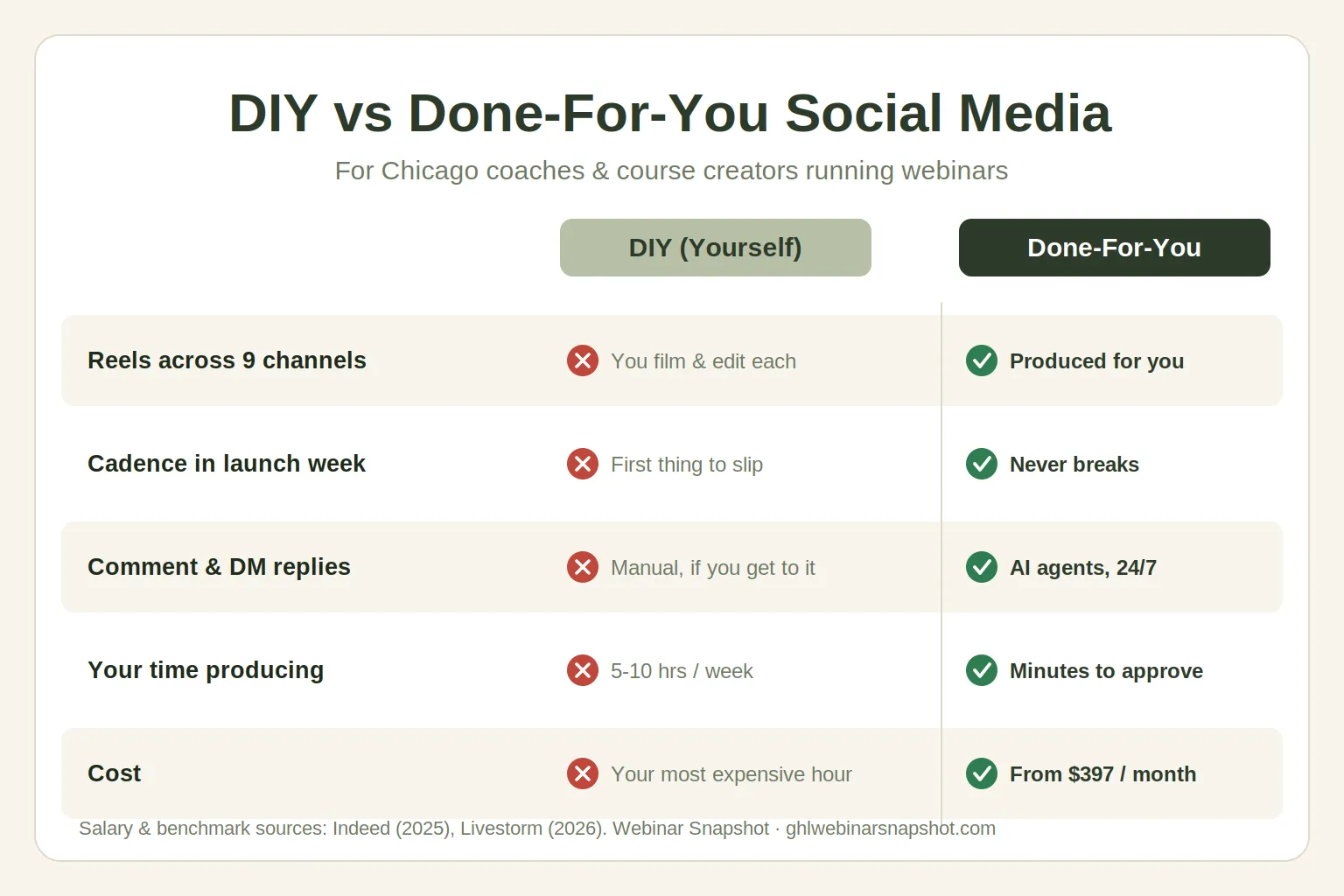
For a Chicago coach or course creator running webinars, done-for-you social media fills more seats than DIY — not because your content is worse, but because filling a live room depends on posting the right format consistently across every channel, and that’s exactly the part solo operators can’t sustain. DIY wins on cost and control on paper. In practice, the webinar that packs the room is the one promoted by five short-form videos a week for three weeks straight — and that cadence is where DIY quietly collapses under everything else you already do.
This is an honest comparison, written for operators who’ve tried both. We’ll look at what each approach actually costs, what the current Reels and posting-frequency data says about reach, and which model reliably drives registrations you can then convert into attendees and sales calls.
Table of contents
- DIY vs done-for-you social media: what each actually means
- The real cost of DIY (it’s not the tools)
- Why Reels are the seat-filling format now
- The consistency problem DIY can’t solve
- Why this hits Chicago operators especially hard
- DIY vs done-for-you, side by side
- Social fills the seat only if automation catches it
- FAQ
DIY vs done-for-you social media: what each actually means
DIY social media means you (or a part-time hire) plan, film, edit, caption, schedule, and post everything yourself; done-for-you means a team runs your channels end to end — content, posting cadence, and engagement — so you only show up to teach the webinar. The distinction that matters for webinar operators isn’t “who presses publish.” It’s who guarantees that the right format goes out on enough channels, often enough, in the weeks that decide whether your room is full or half-empty.
Here’s the honest version of each:
- DIY gives you total control and near-zero hard cost. You keep your voice, you move fast, and the only line item is your scheduling tool. The catch is that every hour spent editing a Reel is an hour not spent selling, coaching, or building your offer — and when launch week gets busy, social is the first thing that slips.
- Done-for-you trades some hands-on control for reliability and reach. A done-for-you social team produces platform-native content across every channel, posts on a fixed cadence, and keeps the engine running whether or not you’re heads-down on a launch. You approve; you don’t produce.
Neither is universally “better.” The right answer depends on how many channels you need to be on, how much video you can realistically ship each week, and what your time is worth. The data below makes that trade-off concrete.
The real cost of DIY (it’s not the tools)
The true cost of DIY social media isn’t your $30/month scheduler — it’s the 5–10 hours a week of owner time it quietly eats, valued at what your hour is actually worth. For a coach billing $200+/hour or preparing a high-ticket launch, that’s the most expensive content in the world.
Start with the labor math. If you hired the work out as a role, you’d be looking at real salary numbers: an in-house social media manager averages about $64,760 a year according to Indeed (2025), and Glassdoor puts the broader content-manager range near $71,000. Step up to a full marketing manager who can own strategy, and the U.S. Bureau of Labor Statistics lists a median wage of $161,030 (May 2024). DIY doesn’t erase that cost — it just moves it onto your own calendar at your own (higher) hourly rate.
Now compare that to done-for-you. A managed webinar-social package runs $397/month — roughly $4,764 a year for content across nine channels plus AI agents that answer comments and DMs. Put the annual numbers side by side and the “DIY is cheaper” story only holds if you value your own hours at close to zero.
The point isn’t that DIY is wrong. For a single-channel operator with genuine spare hours, DIY is perfectly rational. The point is that “free” is the wrong word for it — the real question is whether your hours are better spent producing content or producing revenue.
Why Reels are the seat-filling format now
Short-form video is the format that reaches people who don’t already follow you — which is exactly who you need to fill a new webinar — and it now out-performs static posts by a wide margin. If your DIY output is mostly graphics and carousels, you’re posting into the format that’s losing reach fastest.
The current numbers are stark. In Metricool’s 2026 Instagram study, Reels averaged a 1.23% engagement rate, versus 0.99% for carousels and 0.70% for photos, while single-image posts saw reach fall roughly 22% year over year. Video isn’t just marginally ahead; static content is actively declining.
This matters for webinars specifically because your growth problem is a reach problem. Email fills the room from people who already know you — Livestorm’s 2026 benchmark found 86.3% of registrations come from email. Reels are how you get new people onto that email list in the first place. And the broader video ROI data backs the effort: Wyzowl’s 2025 report found 85% of video marketers say video helped generate leads and 83% say it directly increased sales.
The DIY trap is that Reels are the hardest format to produce consistently — filming, editing, captioning, and cropping for each platform is real work. So the exact format that fills seats is the one solopreneurs ship least. A done-for-you social team inverts that: they turn one recording of you teaching into a week of platform-native Reels for TikTok, Instagram, YouTube Shorts, and Facebook, cropped and captioned per channel. For a deeper look at organic promotion, our guide on how to promote a webinar on LinkedIn covers the B2B side of the same playbook.
The consistency problem DIY can’t solve
Consistency, not creativity, is the single biggest predictor of social growth — and it’s the first thing that breaks when one busy person owns everything. You don’t need viral genius to fill a webinar; you need to show up on schedule for the three weeks before it.
The frequency data is unambiguous. ZoomSphere’s 2025 “Frequency Formula” report found that brands posting 3–5 times a week grew roughly twice as fast as those posting once or twice, with the strongest accounts pushing toward six to nine posts a week. Cadence scales reach almost linearly until you hit diminishing returns.
Here’s why DIY loses this one. Consistency requires slack in your schedule that a launch destroys. In webinar season you’re writing the talk, building the offer, running rehearsals, and answering prospects — and the daily post is the first casualty. You go quiet for two weeks in the exact window when reach compounds. A managed team doesn’t have a launch to prep; posting is their job, so the cadence never breaks. That reliability is the whole product.
Launch week: DIY vs done-for-you
It's the week before your masterclass. You meant to post daily Reels, but you're deep in slide edits and prospect DMs. Three days go dark. The algorithm cools, your reach dips right when it should peak, and registrations trickle in from email alone. You promise yourself next launch will be different.
Your done-for-you team has been posting platform-native Reels five days a week for three weeks straight — countdown clips, teaching snippets, and social proof — while AI agents answer every 'when's the next one?' comment and DM. You show up to teach a full room. The cadence never depended on your free time.
Why this hits Chicago operators especially hard
Chicago is one of the densest professional and creator markets in the Midwest, which means more coaches competing for the same local feeds — and a faster path to a louder competitor when you go quiet. For a Chicago operator, consistency isn’t just a growth lever; it’s how you avoid being out-posted in your own niche.
The local business context reinforces it. A 2025 survey of 200 Illinois small-business leaders by the Chicagoland Chamber of Commerce found that SMBs increasingly rely on digital and social advertising to compete and grow, and UIC’s 2025 Chicagoland Small Business Outlook documented continued growth expectations alongside tighter competition. Translation: your local peers are leaning into social, not out of it.
Two things follow for a Chicago coach or course creator:
- Silence gets punished faster in a crowded market. When a prospect in your niche sees a competitor posting daily and you posting monthly, the daily poster becomes the default authority. Reels are how a smaller Chicago account still reaches non-followers and stays visible between launches.
- Multi-channel presence is table stakes. Your audience is split across LinkedIn (B2B founders), Instagram and TikTok (coaches and course buyers), and YouTube (evergreen discovery). Covering all of them by hand is a full-time job; a done-for-you package covers nine channels at once, which is how a solo operator competes with a team.
If you’re weighing whether to invest here, the honest read is that a dense market rewards the operator who shows up consistently across channels — and that’s precisely the outcome DIY struggles to guarantee.
DIY vs done-for-you, side by side
For most Chicago webinar operators, the real comparison isn’t DIY vs a $161K marketing hire — it’s DIY vs a managed service that costs less than a part-time contractor and never misses a posting day. Here’s the head-to-head.
DIY vs done-for-you social media for webinar operators
| Feature | Done-For-You | DIY |
|---|---|---|
| Weekly Reels across 9 channels | Produced + posted for you | You film, edit, caption, crop each |
| Posting cadence during launch week | Never breaks — it's their job | First thing to slip when busy |
| Comment + DM replies that register attendees | AI agents handle it 24/7 | Manual, if you get to it |
| Hard cost | From $397/mo (~$4,764/yr) | Tools only — but 5–10 hrs/wk of your time |
| Control over voice + message | You approve every post | Total — you make everything |
| Time you spend producing | Minutes to approve | Hours every week |
| Best for | Multi-channel operators short on time | One channel + genuine spare hours |
The decision comes down to a single question: do you have the hours to ship five platform-native Reels a week, every week, across the channels your audience actually uses? If yes, DIY keeps your costs near zero and your voice fully your own. If no — and most operators running live webinars honestly don’t — done-for-you buys back the cadence and the reach for less than the cost of the registrations you’re currently leaving on the table.
Social fills the seat only if automation catches it
Whichever way you produce content, social media only fills the room if the registration it generates survives the gap between sign-up and start time — and that’s an automation problem, not a content problem. This is the part both DIY and done-for-you operators miss: driving the click is half the job.
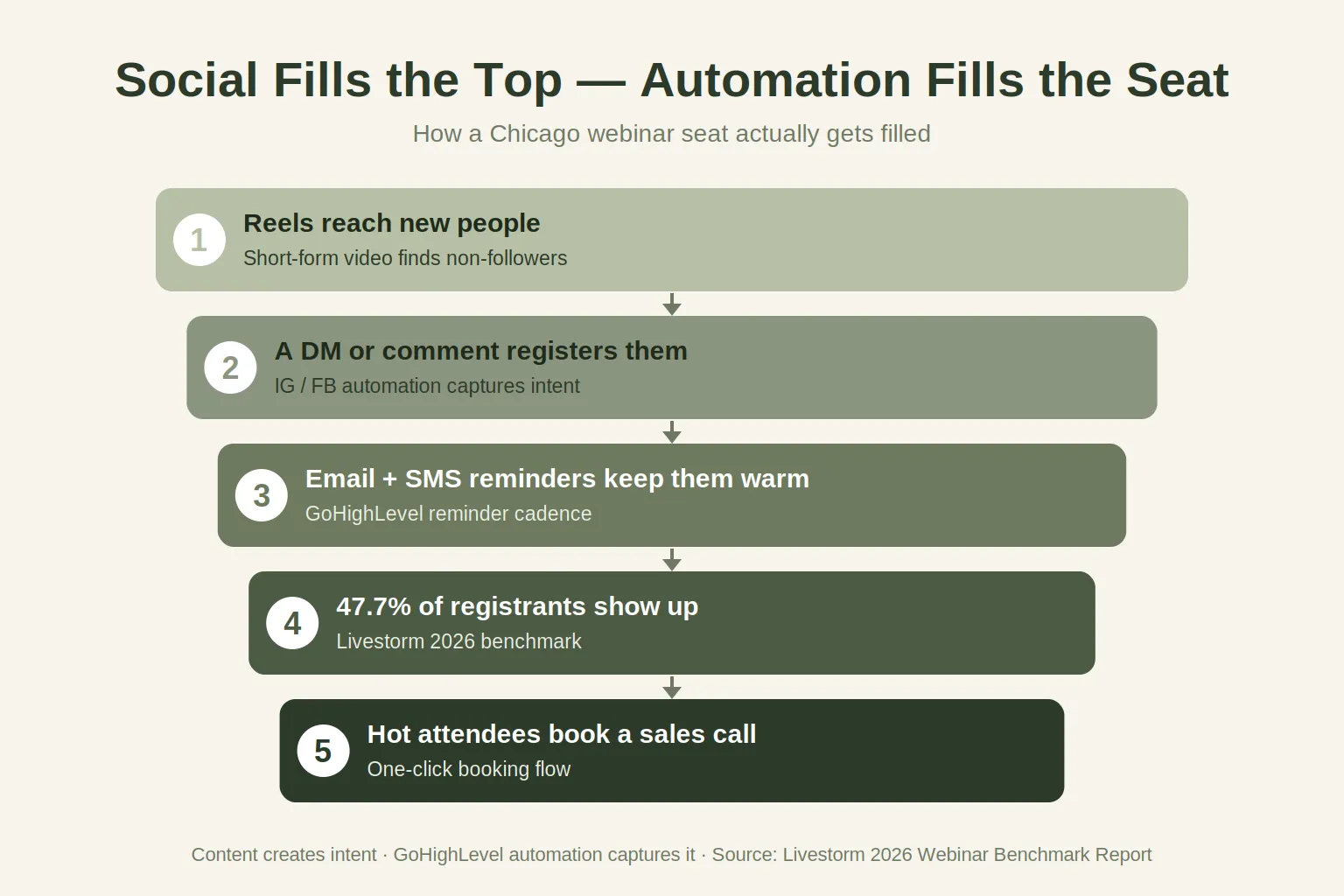
The benchmark reality is sobering. Even with a full registration list, only 47.7% of registrants actually show up (Livestorm, 2026), and ON24’s 2025 report puts the registration-to-attendee conversion around 57% for well-run B2B events. A Reel that drives a registration is wasted if that person never gets a reminder and forgets by showtime.
That’s where your social effort connects to a system. Once social drives the sign-up:
- A reminder cadence of email and SMS keeps registrants warm from sign-up to showtime, lifting show-up rate.
- Facebook Messenger and Instagram DM automation turn the “when’s the next one?” replies your Reels generate into actual registrations, instantly.
- After the event, no-show recovery and replay tracking catch the 50%+ who registered but didn’t attend.
This is exactly why our done-for-you social service ships with three AI agents — for comments, DMs, and web chat — wired into GoHighLevel: the content creates intent, and the automation captures it before it cools. If you want the full picture on the numbers behind the funnel, our 2026 webinar benchmarks post breaks down every stage. DIY or done-for-you, the content is only the top of the funnel — the seat gets filled downstream.
FAQ
Is done-for-you social media worth it for a small webinar business?
It depends on the value of your time and how many channels you need. Done-for-you social starts around $397/month, versus roughly $64,760 a year for an in-house social media manager (Indeed, 2025) or 5–10 hours of your own week for DIY. For a coach or course creator whose hours are worth more producing offers and selling than editing Reels — and who needs to be on multiple channels — done-for-you is usually the cheaper option once you price your own time honestly.
Why do Reels matter more than regular posts for filling webinars?
Because short-form video is the format that reaches people who don't already follow you — the new audience you need to grow a registration list. In Metricool's 2026 Instagram study, Reels averaged a 1.23% engagement rate versus 0.70% for photos, while single-image reach fell about 22% year over year. Email fills your room from people who already know you (86.3% of registrations, per Livestorm), but Reels are how new people find you in the first place.
Can't I just post consistently myself?
You can, and if you have the spare hours, DIY is perfectly rational. The problem is that consistency breaks precisely during launch week, when you're building the offer and prepping the talk — the exact window when reach should be compounding. Brands posting 3–5 times a week grow roughly twice as fast as those posting 1–2 times (ZoomSphere, 2025), and a managed team keeps that cadence because posting is their only job, not your fifth priority.
Does social media actually fill webinar seats, or just registrations?
Social media fills the top of the funnel — it drives registrations, especially from new audiences via Reels. But only about 47.7% of registrants show up (Livestorm, 2026), so the registration only becomes a filled seat if a reminder-and-booking system catches it. Social creates the intent; an automated email/SMS reminder cadence and DM automation convert that intent into attendance. You need both.
How is this different for Chicago coaches specifically?
Chicago is a dense professional and creator market, so more local peers are competing for the same feeds, and a 2025 Chicagoland Chamber survey found Illinois SMBs increasingly rely on digital and social advertising to compete. In a crowded market, going quiet is punished faster, and multi-channel consistency is what keeps a smaller account visible. That raises the bar on cadence — which is the hardest thing to sustain DIY.
What does the done-for-you social package actually include?
It covers content and posting across nine channels — Facebook, Instagram, Google Business Profile, LinkedIn, TikTok, YouTube, Pinterest, Threads, and Bluesky — plus three AI agents that reply to comments, answer DMs, and run web chat to register attendees. It's built for webinar operators specifically, cropped and captioned per platform, from $397/month with no setup fees. You approve the content; the team produces and ships it.
About the author
Priya Shankar is a Course Launch & Conversion Coach based in Seattle, WA. She came up through online education and content marketing, so she thinks as much about the offer and the room energy as the systems underneath it. She works with course creators and founders who teach to sell — masterclasses, demos, and high-ticket coaching webinars — and writes about connecting the human side of a live event to the content and automation that fill it.
Related reading
- How to Promote a Webinar on LinkedIn: The Organic B2B Playbook
- Facebook Ads for Webinars: What Actually Fills Seats
- 2026 Webinar Benchmarks: Show-Up Rates, Conversion, and What’s Normal
- The Webinar Conversion Funnel: Where Registrants Leak and How to Plug It
- The Best Time to Host a Webinar (Backed by Data)
Sources
- Metricool — 2026 Instagram Study (engagement by format; single-image reach)
- ZoomSphere — The Frequency Formula (posting cadence vs growth)
- Wyzowl — State of Video Marketing 2025 (video ROI, leads, sales)
- U.S. Bureau of Labor Statistics — Advertising, Promotions, and Marketing Managers (May 2024)
- Indeed — Social Media Manager Salary (2025)
- Glassdoor — Social Media Content Manager Salary
- Livestorm — 2026 Webinar Benchmark Report (47.7% show-up; 86.3% email)
- ON24 — 2025 Webinar Benchmarks Report (registration-to-attendee)
- Chicagoland Chamber of Commerce — Illinois SMB Digital Advertising Survey (2025)
- UIC Business — 2025 Chicagoland Small Business Outlook