
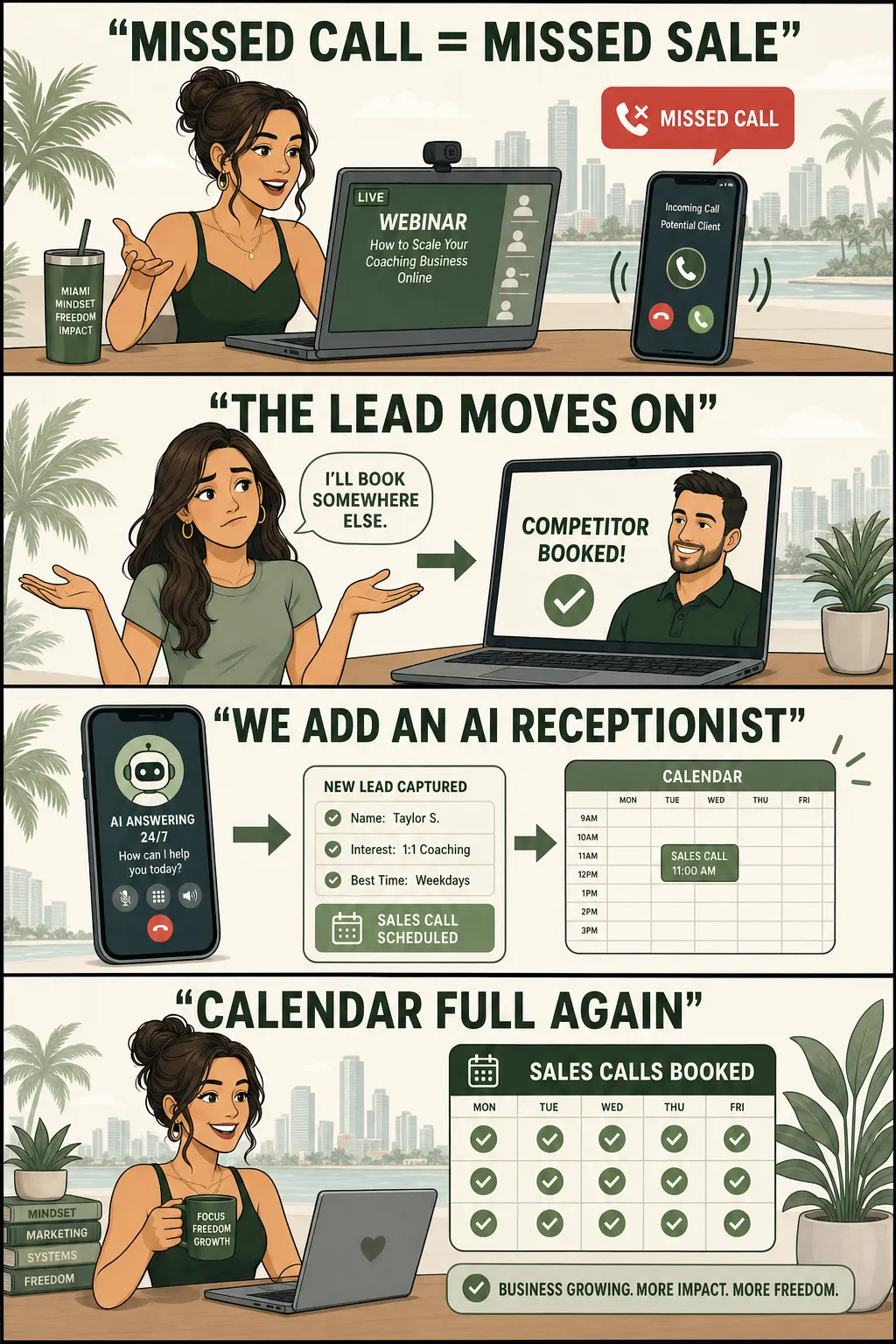
An AI receptionist is a 24/7 AI voice agent that answers your phone, qualifies the caller, and books them onto your calendar — and for a Miami coach or course creator running webinars, it plugs the single most expensive leak in your funnel: the inbound call that comes in while you’re on stage, in a session, or asleep. You spend money and hours filling a webinar, but the hottest leads — the ones motivated enough to call — hit voicemail and quietly move on. The math on that leak is worse than most operators think, and it’s fixable.
Here’s the uncomfortable part: the caller who picks up the phone is usually your best-fit buyer, and the window to win them is measured in minutes, not days. This post lays out why missed calls bleed webinar revenue, what the speed-to-lead research actually says, what a missed call is really worth, and how a done-for-you AI receptionist closes the gap — with every figure sourced.
Table of contents
- What is an AI receptionist — and why do Miami coaches need one?
- The hidden leak: how missed calls drain your webinar funnel
- Speed-to-lead: the window that decides the sale
- What a missed call actually costs you
- Why this hits Miami especially hard
- How an AI receptionist fixes it
- AI receptionist vs voicemail vs human-only
- FAQ
What is an AI receptionist — and why do Miami coaches need one?
An AI receptionist is a natural-sounding AI voice agent that answers inbound calls around the clock, asks qualifying questions, books strategy or discovery calls directly onto your calendar, transfers hot leads, and texts you a summary of every conversation. For a coach, course creator, or B2B founder who runs webinars, it’s the difference between capturing the lead who calls at 9:14 p.m. after watching your replay and losing them to voicemail.
Most webinar operators are, by necessity, unavailable exactly when their best leads reach out. You’re presenting live, coaching a client, filming content, or off the clock. The phone rings, and the person on the other end — someone motivated enough to skip the form and call — gets a voicemail greeting. The conversational-AI market has grown up specifically to close that gap: it’s projected to expand from $11.58 billion in 2024 to $41.39 billion by 2030, a 23.7% compound annual growth rate (Grand View Research). Voice agents that once sounded robotic now hold a real qualifying conversation, and that’s why they’ve moved from novelty to infrastructure for lead-driven businesses.
For webinar businesses in particular, the AI receptionist isn’t a replacement for your funnel — it’s the safety net under it. The registration page, the reminder cadence, and the replay all do their job of creating intent. The receptionist makes sure that when that intent turns into a phone call, someone answers.
The hidden leak: how missed calls drain your webinar funnel
The leak isn’t at the top of your funnel — it’s at the bottom, where a high-intent caller meets a voicemail box. Operators obsess over cost-per-registration and show-up rate, then let the most valuable action a prospect can take, a phone call, fall on the floor.
Start with who’s calling. The inbound caller is not a cold click; they’re a warm, self-selected buyer. And the data on their value is lopsided:
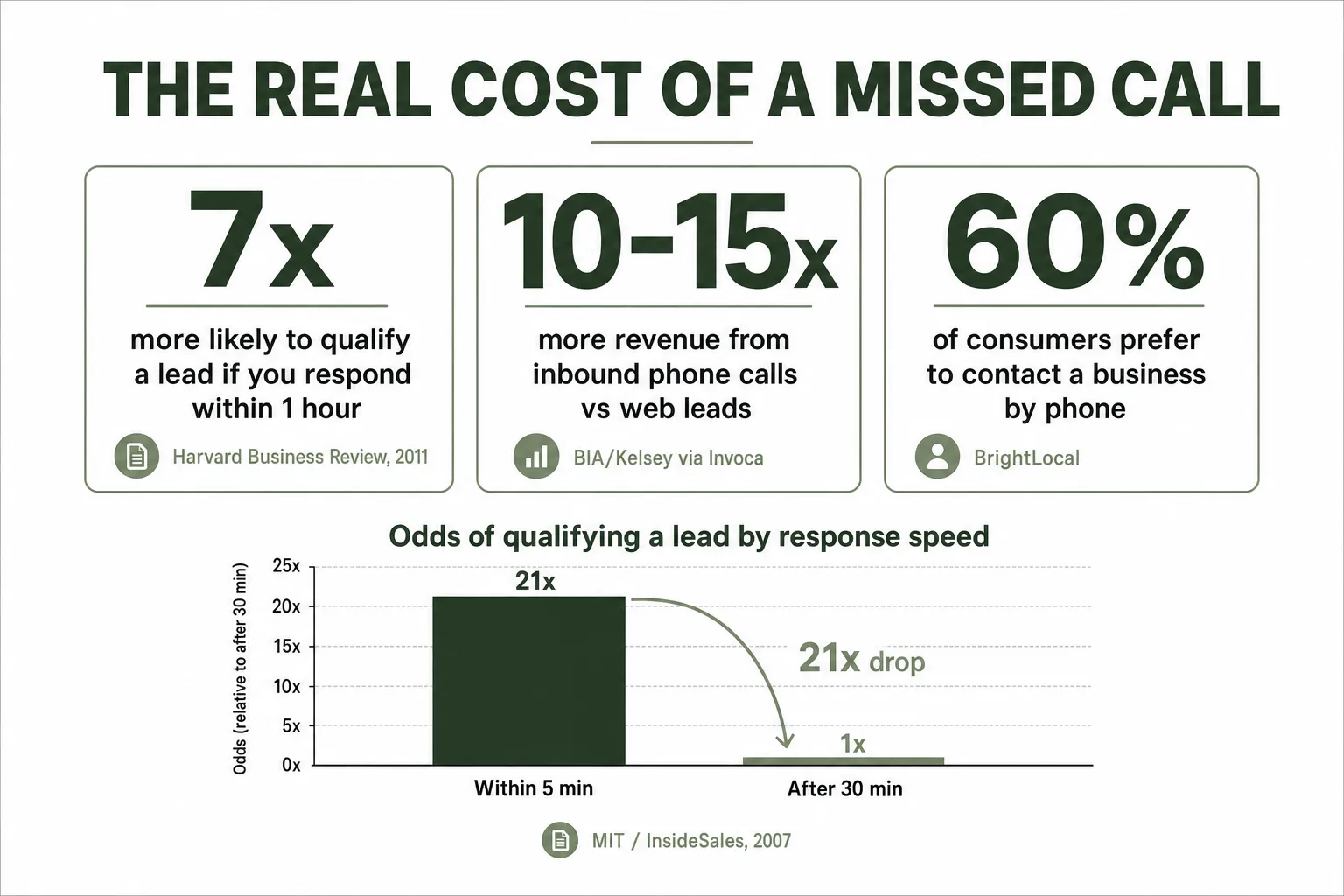
- Phone leads are worth more. Inbound phone calls convert to 10–15x more revenue than web leads, per BIA/Kelsey research popularized by Invoca. Someone willing to talk is closer to buying than someone who filled a form.
- People still want to call. Despite every chat widget and DM channel, 60% of consumers say they prefer to contact a small business by phone, versus 16% by email and 15% in person (BrightLocal).
- But the call usually isn’t answered. A 2024 analysis by 411 Locals found only 37.8% of incoming calls were answered by a live person across the businesses it studied — meaning the majority rolled to voicemail, a menu, or nothing.
- And voicemail is a dead end. Research from BIA/Kelsey, reported in CRM Magazine, found most callers who reach a business voicemail simply hang up without leaving a message. No callback list, no lead — just silence.
Put those together and the picture is stark: your most valuable lead, taking the action they most prefer, hits a wall the majority of the time and doesn’t leave a trace. For a solo coach or a lean course business, there is no front desk catching the overflow. The call is the lead, and the missed call is the lost sale.
Speed-to-lead: the window that decides the sale
Even when a call or inquiry does get through, how fast you respond decides whether it becomes a booked call — and the decay is brutal. This is the most rigorously studied part of the whole problem, and the numbers are dramatic enough to reorganize how you handle inbound.
The canonical study is Dr. James Oldroyd’s MIT / InsideSales Lead Response Management research, built on more than 15,000 leads and 100,000 call attempts. It found that contacting a web lead within 5 minutes, versus 30 minutes, made you about 21x more likely to qualify that lead — and roughly 100x more likely to reach them at all.
The Harvard Business Review study The Short Life of Online Sales Leads, covering 2,241 US companies, reached the same conclusion from a different angle: firms that reached out within an hour were 7x more likely to have a meaningful qualifying conversation than those that waited just one hour longer — and 60x more likely than those that waited 24 hours or more. Yet the same study found the average company took about 42 hours to make first contact, and 23% never responded at all.
A human can’t win this game reliably. You cannot answer within five minutes when you’re mid-webinar, and you can’t answer at 11 p.m. when someone finishes your evergreen replay and reaches for the phone. This is exactly the gap an AI follow-up system — and an AI receptionist for live calls — is built to cover: the response happens in seconds, every time, regardless of what you’re doing.
What a missed call actually costs you
The cost of a missed call isn’t the call — it’s the deal behind it, multiplied by how many you miss over a year. Rather than lean on the inflated “$126,000 a year” figures floating around content-mill blogs (which have no real methodology), it’s more honest to build the number from your own inputs.
Here’s a simple, illustrative model for a coach selling a high-ticket program:
The cost of a missed call — an illustrative example
You run a webinar that drives 8 inbound calls a month. You catch about half; the rest hit voicemail and don't call back. Of the 4 you miss, historically 1 would have booked and closed on a $3,000 program. That's ~$3,000/month — roughly $36,000 a year — evaporating at the voicemail beep, on top of the ad spend that generated the call.
An AI receptionist answers all 8 calls, qualifies them, and books the ready-to-buy callers straight onto your calendar — day or night. Recovering even that one missed close a month pays for the system many times over, and you keep the leads you already paid to create.
The exact figures will differ for your business — plug in your own call volume, close rate, and program price. But the shape holds for almost everyone: because phone leads convert at a multiple of web leads, each missed call is disproportionately expensive. And these leaks compound with the ones you already have elsewhere in the funnel — the no-shows you never recover and the registrants who leak between each stage. Plugging the phone leak is often the fastest ROI of the bunch because the intent is already at its peak.
Why this hits Miami especially hard
Miami is one of the densest small-business and creator markets in the country, which means more competition for the same webinar audience — and a faster path to a competitor when your line goes to voicemail. Florida is home to 3.3 million small businesses, 99.8% of all businesses in the state, employing 3.6 million people or 40.9% of the state’s workforce, according to the U.S. Small Business Administration’s Office of Advocacy (2024).
The creator and founder concentration is real, too. Miami–Fort Lauderdale startups raised $2.77 billion in 2024, ranking South Florida a top-10 US venture hub (Refresh Miami / eMerge Insights). For a coach or course creator here, that density cuts both ways:
- Your prospect has options. If someone finishes your masterclass, calls, and reaches voicemail, there’s another Miami coach in the same niche one search away. Call-tracking data suggests a large share of inbound calls arrive outside standard business hours — precisely when a solo operator can’t pick up — so “I’ll call them back tomorrow” often means “they’ve already booked with someone else.”
- A bilingual, always-on front line is an edge. Miami’s market is heavily bilingual, and a modern AI receptionist can greet and qualify callers in English or Spanish, 24/7, without you staffing a night desk. That’s a genuine local advantage, not a nice-to-have.
If you’re competing for attention in a crowded local market, the operators who answer every call — instantly, at any hour — quietly win the leads everyone else is letting slip.
How an AI receptionist fixes it
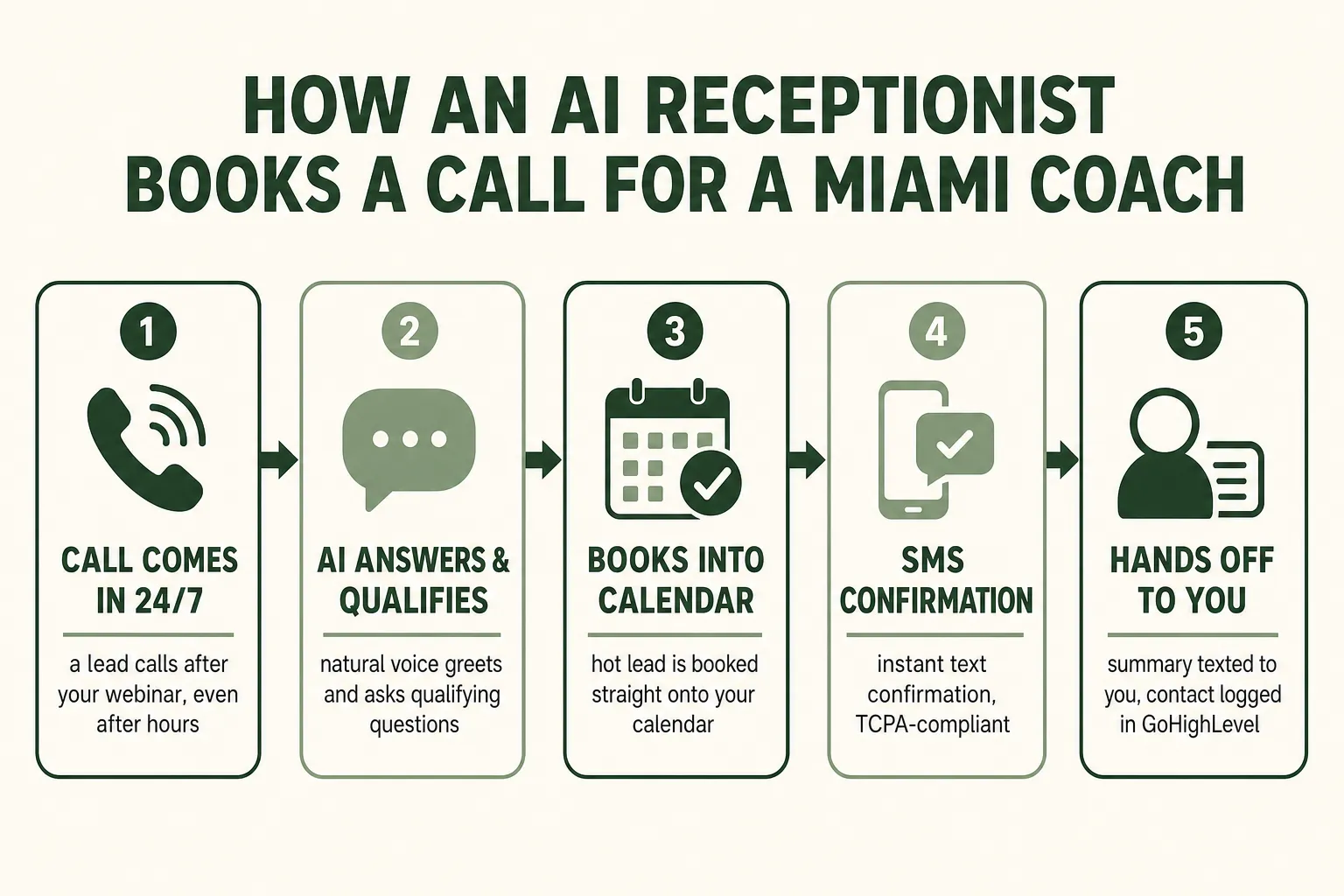
A well-built AI receptionist turns every inbound call into a structured, booked, logged event — no voicemail, no lost lead, no 3 a.m. staffing. Here’s the workflow, end to end, wired into the same GoHighLevel system that already runs your webinar reminders and pipelines.
The pieces that make it work:
- It answers instantly, 24/7. The AI picks up on the first rings in a natural voice — no hold music, no menu maze. That alone beats the ~62% of calls that never reach a live person.
- It qualifies before it books. Using your criteria (budget, program fit, timeline), it separates a ready-to-buy caller from a support question, so your calendar fills with real opportunities, not tire-kickers. This mirrors how lead scoring ranks your webinar attendees — only in real time, on the phone.
- It books straight onto your calendar. Hot leads are placed directly into an open strategy-call slot, hitting that 5-minute speed-to-lead window automatically.
- It confirms by SMS — compliantly. An instant text confirmation goes out, and the contact is tagged in GoHighLevel. Because this is voice and SMS, consent and opt-out handling matter: build it to respect TCPA and A2P 10DLC rules from day one, not as an afterthought.
- It hands off with context. You get a texted summary of every call and a fully logged CRM contact, so when you do talk to the prospect, you already know why they called.
This is precisely the kind of system our team builds. Our AI Voice Receptionist is built on production voice stacks (VAPI / Retell + Claude + Twilio), trained on your exact offer and qualifying questions, and wired into your GoHighLevel so every call becomes a booked, tagged, followed-up opportunity — typically live in about 2–3 weeks. It pairs naturally with the AI Caller feature in our webinar snapshot, which handles the outbound side: reminders and no-show recovery.
AI receptionist vs voicemail vs human-only
For a lean webinar business, the honest comparison isn’t AI vs a full-time receptionist — it’s AI vs the voicemail box you’re using now. A human front desk is excellent but expensive and off the clock at night; voicemail is cheap but loses the lead. The AI receptionist sits where most solo operators and small teams actually need it.
AI receptionist vs voicemail vs a human-only front desk
| Feature | AI Receptionist | Voicemail / Human-only |
|---|---|---|
| Answers 24/7 (nights, weekends, mid-webinar) | Yes — always on | Voicemail only / business hours |
| Responds within the 5-minute window | Instant, every call | Hours to days (or never) |
| Qualifies the caller before booking | Yes, by your criteria | Voicemail: no · Human: yes |
| Books straight onto your calendar | Automatic | Manual callback required |
| Logs + tags the contact in your CRM | Automatic | Rarely / manual |
| Monthly cost | Fraction of a hire | Voicemail: free · Human: full salary |
Voicemail costs you the lead. A full-time receptionist costs you a salary and still sleeps. The AI receptionist answers every call, qualifies it, books it, and logs it — for a fraction of a hire — which is why it’s become the default front line for lead-driven coaching and course businesses. If you’re weighing where automation pays off first, this is usually it: the intent is already at its peak the moment the phone rings.
FAQ
What is an AI receptionist?
An AI receptionist is a 24/7 AI voice agent that answers your inbound phone calls in a natural human-sounding voice, qualifies the caller against your criteria, books ready-to-buy leads directly onto your calendar, transfers or escalates when needed, and texts you a summary of every call. For a coach or course creator running webinars, it ensures the high-intent lead who calls after your session or replay actually reaches someone instead of hitting voicemail.
Why do missed calls matter so much for a webinar business?
Because the caller is usually your best lead. Inbound phone calls convert to 10–15x more revenue than web leads (BIA/Kelsey), and 60% of consumers still prefer to contact a business by phone (BrightLocal). Yet a 2024 411 Locals analysis found only 37.8% of business calls are answered by a live person, and most callers who reach voicemail don't leave a message. So your most valuable, most motivated leads are the ones most likely to be lost at the voicemail beep.
How fast do I really need to respond to a lead?
Very fast. The MIT / InsideSales Lead Response Management study found that contacting a lead within 5 minutes versus 30 minutes made you about 21x more likely to qualify them. Harvard Business Review found responding within an hour made firms 7x more likely to have a qualifying conversation than waiting one hour longer, and 60x more than waiting 24+ hours. An AI receptionist responds in seconds, every time — a window no human can hit reliably while running webinars.
Is an AI receptionist compliant with TCPA and A2P rules?
It can and must be, when built correctly. Any voice or SMS outreach needs proper consent capture, clear opt-out handling, and A2P 10DLC registration for text messaging in the US. A done-for-you build should handle consent and opt-out as a first-class part of the system, not an afterthought. We build these flows to respect TCPA and A2P 10DLC from the start, but final messaging and compliance posture always remain the operator's responsibility.
How is this different from a chatbot?
A chatbot handles text conversations on your website or social channels — great for registering attendees and answering questions. An AI receptionist handles live phone calls, which are a different, higher-intent channel: the person is calling because they want to talk now. Many webinar businesses use both — a chatbot to capture and register web visitors, and an AI receptionist to catch the phone leads that would otherwise hit voicemail.
How long does it take to set up an AI receptionist?
A custom AI voice receptionist is typically live in about 2–3 weeks. That covers training it on your offer and qualifying questions, connecting it to your calendar and GoHighLevel, setting up SMS confirmations with compliant consent handling, and testing the call flow end to end before it goes live on your line.
About the author
Priya Shankar is a Course Launch & Conversion Coach based in Seattle, WA. She works with course creators and founders who teach to sell — masterclasses, demos, and high-ticket coaching webinars — and thinks as much about the offer and the room energy as the automation underneath it. Her writing connects the human side of a live event to the systems that capture, nurture, and book the people most ready to buy.
Related reading
- How to Use AI for Webinar Follow-Up (2026 Playbook)
- Webinar No-Show Recovery: Win Back the Registrants Who Didn’t Attend
- How to Book Sales Calls From Webinars: The Attendee-to-Consult Playbook
- Webinar Lead Scoring: Call the Right Buyers First
- SMS Reminder Compliance for Webinars (TCPA + A2P 10DLC)
Sources
- Invoca — Call Tracking & Conversation Intelligence Stats (BIA/Kelsey, phone leads convert 10–15x)
- BrightLocal — Consumer Search Behavior (60% prefer phone)
- getAIRA (re-citing 411 Locals 2024 — 37.8% of calls answered live)
- CRM Magazine — Business Voicemail Goes Unanswered (BIA/Kelsey)
- MIT / InsideSales — Lead Response Management Study (PDF)
- Harvard Business Review — The Short Life of Online Sales Leads
- Grand View Research — Conversational AI Market ($11.58B → $41.39B)
- Livestorm — Webinar Metrics (47.7% average show-up rate)
- SBA Office of Advocacy — 2024 Florida Small Business Profile (PDF)
- Refresh Miami — Miami startups raised $2.77B in 2024