
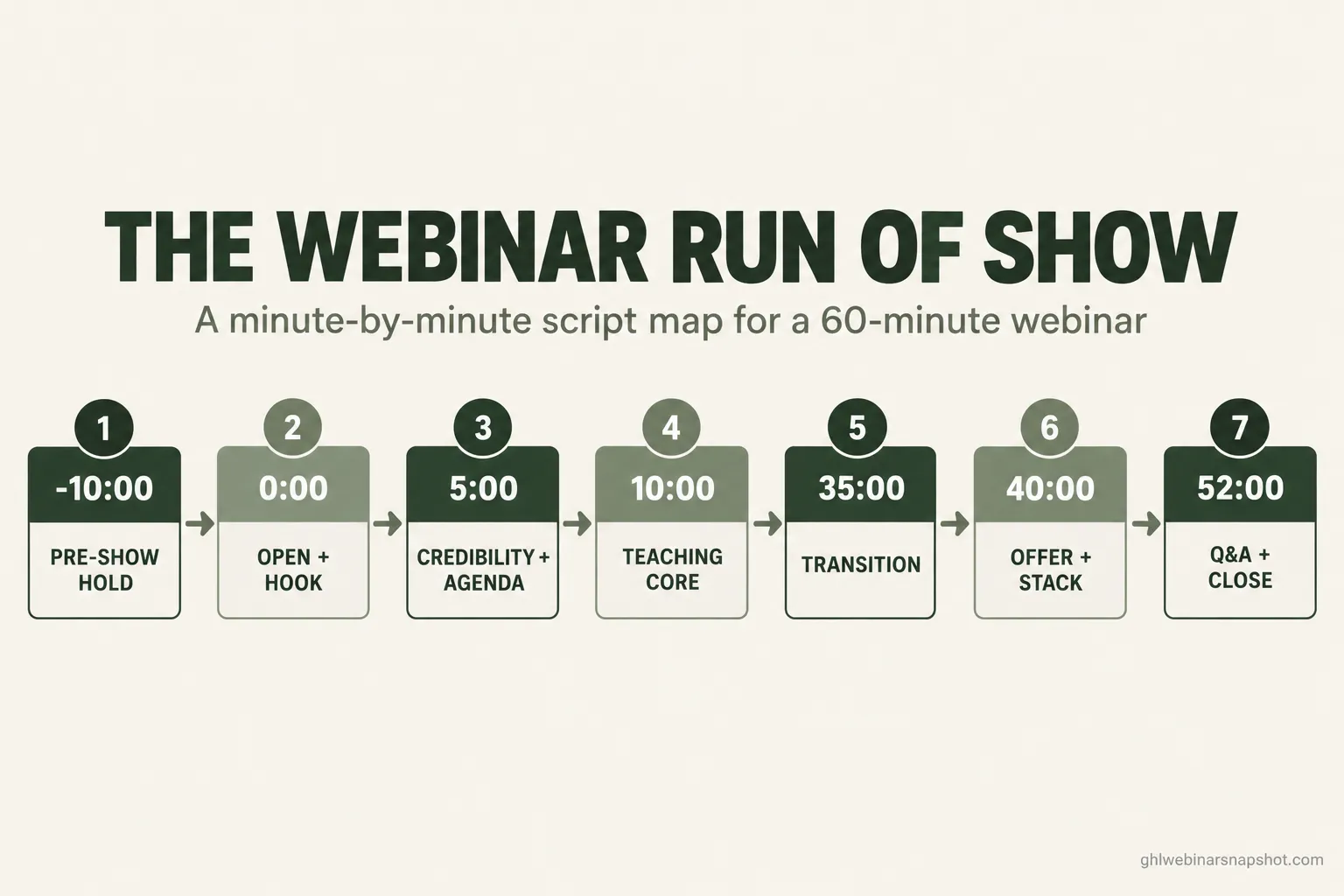
A webinar run of show is a single document that maps every minute of your event, from the countdown before you go live to the words you say when you point people at the next step. The useful version has seven segments: the pre-show hold, the open and hook, credibility and the agenda, the teaching core, the transition to the offer, the offer itself, and the Q&A and close. This post gives you the timing, the real words to steal for each segment, the way each one quietly falls apart, three versions for a solo coach, a mid-size course team, and an enterprise B2B demo, and the recording-consent and earnings-claim rules you have to clear before you hit record. Copy it, change the brackets, and run it.
It is 1:58pm. Forty-one people are in the waiting room, your slides are open, and you have no idea what you are going to say in the first ninety seconds. So you wing the open, ramble through your intro, apologize twice for “technical stuff,” and by the time you get to anything useful a third of the room has clicked away. The content was fine. What broke was that you were improvising a live event in front of a paying audience, and improvisation at 2:00pm costs you the room.
A run of show fixes that. It is not a word-for-word teleprompter script, and it is not a loose bullet list you glance at twice. It is the middle thing: a timed map of what happens, when, and what you actually say at the three or four moments that decide whether anyone books a call. The best operators I know do not have more charisma than you. They have a document.
Table of contents
- Why a run of show beats winging it
- What a disorganized webinar actually costs
- The seven-segment run of show
- Segment 1: The pre-show hold
- Segment 2: The open and the hook
- Segment 3: Credibility and the agenda
- Segment 4: The teaching core
- Segment 5: The transition to the offer
- Segment 6: The offer and the stack
- Segment 7: Q&A and the close
- Three run sheets by business size
- Live versus evergreen: what changes
- The compliance lines baked into the script
- Objections, answered
- FAQ
Why a run of show beats winging it
A run of show beats improvisation because a live webinar punishes hesitation in real time, and you only get one take. Every pause while you decide what to say next is a pause the viewer fills by checking their phone.
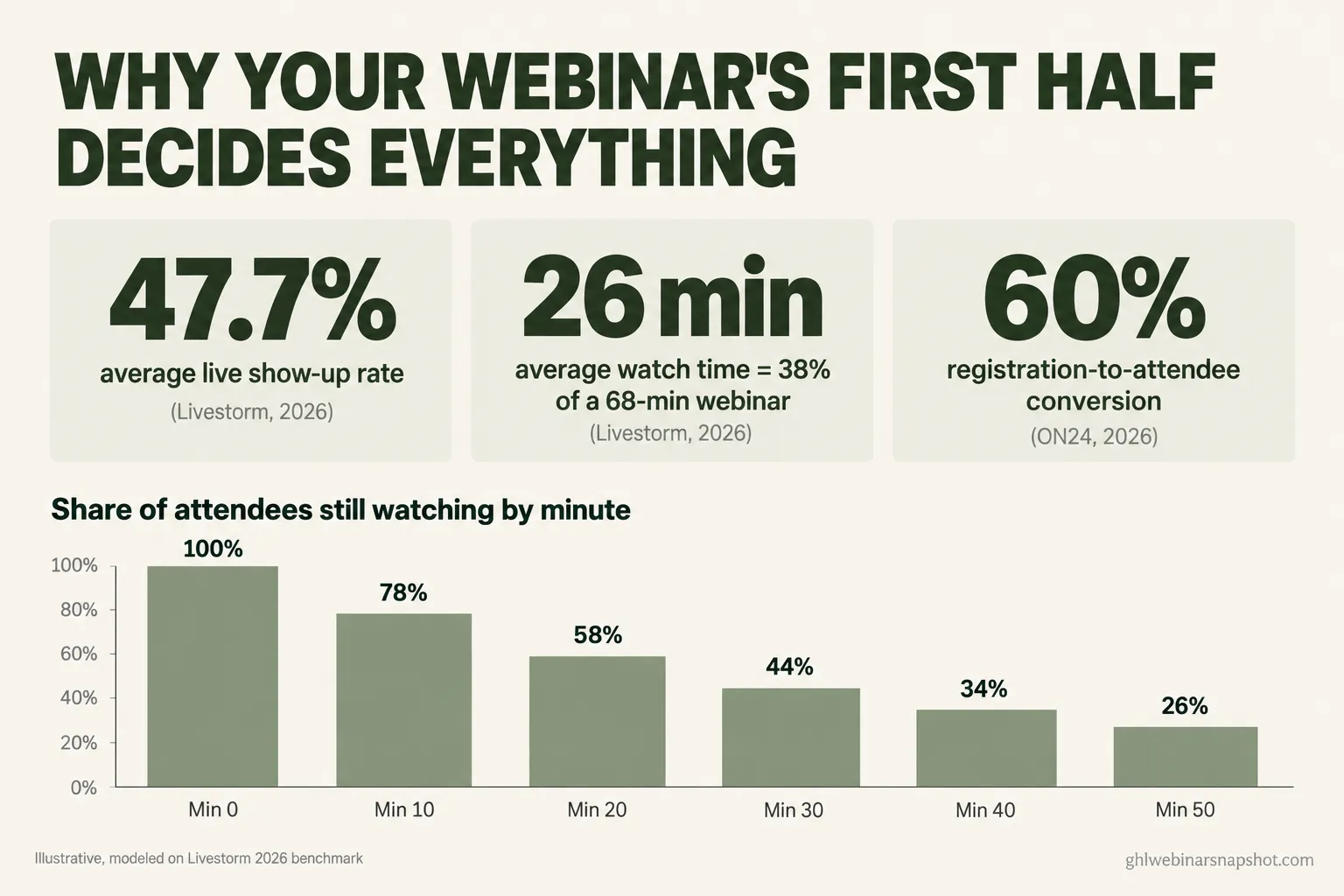
The data on how little time you get is blunt. Across 33,786 sessions and more than seven million registrations, Livestorm’s 2026 benchmark report found the average attendee watches about 26 minutes, which is 38% of a 68-minute webinar. That one number changes how you order your segments: much of the room leaves in the first ten minutes if those ten minutes are sloppy, so the run of show is how you make the early minutes earn their keep and get the offer positioned before the audience thins out.
Sources: show-up rate and watch time from Livestorm’s 2026 Webinar Benchmark Report (47.7%, down from 48.9% in 2024); registration-to-attendee conversion from ON24’s 2026 benchmarks; thought-leadership effectiveness from the CMI and MarketingProfs 2026 B2B trends survey.
A run of show is also the hinge between your marketing and your automation. The SMS and email reminders already got people into the room, and the booking flow picks up after the close. The webinar itself is the one live piece in your own voice, and it is the piece most operators leave to chance. Script it and the whole system works.
What a disorganized webinar actually costs
A messy webinar burns leads at the exact moment they were most ready to buy. Run the math. Say you pay to drive 400 registrations. At the 47.7% average show-up rate, about 190 attend. If your open is weak and your teaching is buried, most leave before you ever reach the offer. You did not lose those leads to a bad product or a bad price. You lost them to the first fifteen minutes and to an offer that showed up after they were gone.
A tight run of show holds more of the room past the ten-minute mark, positions the offer before the drop-off so even early leavers hear it, and ends on a single clear next step. That is not charisma. It is sequencing, and sequencing is what a document fixes.
Attendees from the same 400 registrations at three show-up rates. The 47.7% midpoint is the cross-industry average in Livestorm’s 2026 Webinar Benchmark Report; 60% is the registration-to-attendee conversion ON24 reports for 2026. The 120 attendees you lose between the low and high bars are leads you already paid for.
The seven-segment run of show
Here is the full map for a 60-minute live webinar, in minute markers rather than durations. Adjust the totals for a 45-minute or 90-minute event by stretching the teaching core, never the open or the transition.
The 60-minute run of show at a glance
| Feature | When | What happens |
|---|---|---|
| Pre-show hold | -10:00 to 0:00 | Countdown, music, early-chat prompt, housekeeping |
| Open and hook | 0:00 to 5:00 | Welcome, the promise, who this is for, recording notice |
| Credibility and agenda | 5:00 to 10:00 | Why you, what we cover, the stay-to-the-end reason |
| Teaching core | 10:00 to 35:00 | Three content blocks, each a real win they can use |
| Transition | 35:00 to 40:00 | The bridge from teaching to offer, permission to pitch |
| Offer and stack | 40:00 to 52:00 | The offer, price, bonuses, guarantee, the CTA |
| Q&A and close | 52:00 to 60:00 | Objection-handling, the single next step, the sign-off |
Each segment below gives the timing, the words to steal, and how it breaks.
Segment 1: The pre-show hold
The pre-show hold runs from about ten minutes before start time to zero, and its only job is to turn a nervous waiting room into a warm one. People who show up early are your most motivated buyers. If they stare at a frozen “starting soon” slide in silence, that motivation leaks.
Fill the hold with three things: a visible countdown, low background music, and one chat prompt that gets people typing. A person who has typed once will type again during Q&A, and an active chat makes latecomers feel like they walked into a full room.
Steal this pre-show chat prompt:
Welcome in. While we wait for the room to fill, drop one thing in the chat: what is the single biggest reason [the problem] is costing you right now? I will read a few of these out when we start.
How this breaks: going live into dead air. Opening your mouth at exactly 2:00:00 with zero chat activity makes the first two minutes feel like a sales call nobody wanted. Warm the room during the hold, and start the real content two or three minutes after the hour so the early crowd is already engaged.
Segment 2: The open and the hook
The open runs the first five minutes, and it is the single most important thing you will script word for word. This is where the drop-off is steepest. You have roughly ninety seconds to answer the only question in the viewer’s head: “is this worth my hour?”
Do not open with your bio or a slow “can everyone hear me.” Open with the promise: the specific result they can get by the end, stated as plainly as you can. Then name who it is for, so the right people lean in and the wrong ones leave quickly, which is fine. Somewhere in these five minutes you also deliver the recording notice, covered in the compliance section, because on camera is where it belongs.
Steal this open:
You are here because [specific problem]. In the next 45 minutes I am going to show you the exact [system or framework] that [specific outcome], the same one [brief proof]. This is built for [audience]. If that is you, stay to the end, because the last thing I show you is the piece most people get wrong. Quick note before we start: this session is being recorded.
That open does four jobs in four sentences: promise, proof, qualification, and a reason to stay, plus the recording line.
How this breaks: burying the promise. The classic mistake is a four-minute windup, a personal story, a slow warm-up, and only then the point, by which time the drop-off has already started. Lead with the promise and tell the story later, inside the teaching, where it supports a point instead of delaying one.
Segment 3: Credibility and the agenda
Minutes five to ten establish why they should listen and lay out the map. This is short on purpose. Credibility is not a resume. It is one or two sentences that connect your experience to their problem, and nothing more. The longer you talk about yourself, the more the promise from the open feels like a setup for a pitch.
Then give the agenda as a numbered list of what they walk away with, and name the stay-to-the-end reason again. ON24’s 2026 benchmarks found polls draw the most interaction of any webinar feature, so this is a natural spot for your first poll: a one-tap question that wakes the room up and tells you who is in it.
Steal this agenda frame:
Here is what we are covering. One, [first win]. Two, [second win]. Three, [the mistake almost everyone makes]. Stick around for number three, because it is the reason most [audience] stay stuck even after they do one and two right. Quick poll while we are here: where are you with [the problem] today?
How this breaks: a credibility segment that turns into a highlight reel. If you spend three minutes on your awards, you spend your trust before you have earned it. Keep it to the one credential that maps to their exact problem, then move.
Segment 4: The teaching core
The teaching core, minutes ten to thirty-five, is where you actually help people, and it is the only segment you teach from bullets rather than a script. Scripted teaching sounds robotic. The open and the transition are scripted because they are short and precise; the teaching is longer and needs to breathe, so write it as three content blocks with the key lines noted and talk it like a human.
Three blocks is the number that works. Each is one real win the viewer could act on tomorrow, even if they never buy anything, and you give the win fully. The instinct to hold back your best material so people have to buy it is backwards. Remember the 26-minute average watch time: if you hold your best block for minute 40, most of the room never sees it, so put your strongest teaching in block one or two.
The third block plants the transition. End it on the gap: they now know what to do, and the natural next question is how to do it without spending six months figuring it out. That gap is the bridge to the offer, and it only works if the teaching was genuinely good.
How this breaks: teaching that never resolves into a point, or teaching that is really just a long ad. Both lose the room. If a block does not end with something the viewer could write down and use, cut it. And if the whole core feels like it is stalling until the pitch, people feel that, and they leave before you get there. More on that failure in the attendees drop off before the offer breakdown.
Segment 5: The transition to the offer
The transition is five minutes, minute thirty-five to forty, and it is the segment almost everyone skips. It is also the one that decides whether your pitch feels earned or feels like a bait and switch. A transition is you asking, out loud, for permission to shift from teaching to selling, and giving a reason the offer exists at all.
The move is simple. Acknowledge what you just taught. Name the gap between knowing and doing. Then explain that you built a faster path for the people who want one, and ask if they want to hear about it. The question is not fluff: it resets attention and signals honesty, which is what lowers the guard you need lowered before an offer.
Steal this transition:
So that is the whole framework. You could take those three pieces and build this yourself, and some of you will, and that is genuinely fine. But if you would rather not spend the next three months wiring it together and testing it, I put the whole thing into one system you can use right away. Can I take two minutes to show you how it works? If you are not interested, no problem, the Q&A is coming right after.
How this breaks: no transition at all. One second you are teaching, the next a price slide is on screen, and the warmest people in the room feel ambushed. The five minutes you spend here are what make the next twelve minutes land.
Segment 6: The offer and the stack
The offer runs minutes forty to fifty-two: the thing you sell, what is in it, the price, the bonuses, the guarantee, and a single clear call to action. Order matters. Lead with the outcome, not the feature list, then stack the components so the value is obvious before the price appears and the price feels small against what came before it.
Say the price plainly and once. Hedging on price reads as a lack of confidence in the offer. Put the call to action on screen and in the chat at the same moment, and keep it to one action: one link, one next step. If your goal is a booked call rather than a sale, the call to action is the booking link, and the whole close points at it, a path covered in how to book sales calls from webinars.
Steal this offer stack:
Here is what you get. [Core deliverable], which is the thing that [primary outcome]. Then [component two] and [component three], so you are not stuck on the parts most people get wrong. On top of that, [bonus], because [reason it matters]. All of it is [price]. If you want it, the link is in the chat right now and on your screen. Click it, and I will see you on the other side while we do Q&A.
How this breaks: a feature dump with no outcome, or a price you apologize for. List twelve features without tying them to a result and the viewer cannot tell what they are buying. Any version of “I know it is a lot, but” tells the room the price is wrong before they decide for themselves. Keep every claim inside what you can substantiate, which is both the law and what keeps the offer believable.
Segment 7: Q&A and the close
The last eight minutes, fifty-two to sixty, are Q&A layered over a standing call to action, ending on one unmistakable next step. Q&A is not filler. It is where you handle the objections the offer raised in public, which is far more powerful than handling them one at a time later. Seed it if you have to: there is always a real question you get every time, so ask it yourself and answer it.
Keep the call to action on screen the entire time, and end every answer with a soft return to it. Close on a single concrete next step, not a vague “let me know if you have questions.” Tell them exactly what happens next, whether that is clicking the link, booking a call, or watching for the replay email that hands off to the follow-up sequence you already built.
Steal this Q&A seed and close:
A question I get every time: “what if I have tried something like this before and it did not work?” Fair. The difference is [specific reason]. Keep them coming in the chat. And if you already know this is for you, do not wait for the replay, the link is right there. We go live again [next date], but the people who move today are the ones I see book a call this week. Thanks for spending the hour with me. See you on the other side.
How this breaks: ending soft. “Thanks everyone, have a great day” with no next step is where a good webinar dies. The person who was ninety percent there needed one more nudge toward one action, and you gave them a wave instead. If your webinar leads consistently go quiet, the why webinar leads will not book the call breakdown covers the handoff.
Three run sheets by business size
The seven segments are the same at every size. What changes is who runs them and how heavy the production is.
Solo coach, low-ticket course
You are the host, producer, and moderator at once, so simplify ruthlessly. Run a single screen, one poll, and skip the formal pre-show: your hold is you on camera, reading chat out loud. The offer is one product at one price, and the close points at a checkout link. Because you cannot watch chat and present at once, batch Q&A into the last segment. Your edge here is intimacy, so lean into it rather than faking a big-production feel you cannot staff.
Mid-size course team
With a second person on chat and tech, the run of show gains a parallel track: yours is what you say, theirs is what fires when. The moderator posts the poll, drops the offer link on your cue, pins the call to action, and feeds you the three best questions for Q&A so you are not scanning chat mid-sentence. A bigger room means more skeptics, so the permission-to-pitch transition pays off most here. Your offer can carry a bonus stack and a short deadline, since you have the hands to manage the follow-up.
Enterprise B2B demo
The goal is almost never a checkout. It is a booked follow-up with a salesperson, and the whole run of show bends toward that. Your “offer” segment is a product walkthrough that ends in a meeting request, not a price; credibility leans on customer logos and a named use case. You will likely run with a producer and a subject-matter expert, so the run sheet assigns who speaks when, and Q&A is often where the real selling happens because procurement-minded buyers ask sharp questions. Given that 52% of B2B marketers rate webinars among their most effective thought-leadership channels, this version optimizes for pipeline quality over raw attendance, and the close hands qualified attendees straight into the CRM.
Live versus evergreen: what changes
An evergreen webinar runs the same seven segments, but nobody is actually in the room, and that one fact changes how you build the run sheet. The full trade-offs are covered in the live versus evergreen breakdown.
Same segments, different mechanics
| Feature | Live | Evergreen |
|---|---|---|
| Pre-show hold | Real countdown, you read chat aloud | Timed countdown page, no host presence |
| Chat and polls | Real responses, answered live | Scheduled prompts, automated or moderated |
| Q&A | Live, in your voice | Pre-recorded FAQ block or a live chat agent |
| The offer | You present it on camera | A timed pop-up CTA at the offer mark |
| Urgency | Natural, the event is happening now | Engineered with session-based deadlines, used honestly |
| Biggest risk | You freeze or run long | It feels fake-live and viewers notice |
The honesty line matters for evergreen. Label a recording as happening live right now and viewers who catch the seam lose trust fast. Run evergreen as “watch instantly” or “next session starts in X minutes,” both of which are true, and let the timed CTA do the urgency work. The run of show still maps every minute, it just maps what the automation does instead of what you say.
The compliance lines baked into the script
Two compliance moments live inside the run of show itself, which is exactly why you script them: so you never forget them live.
The recording notice, in the open. If you record a webinar with live audience audio or video, consent-to-record laws can apply and they vary by state. Roughly eleven states follow an all-party consent standard rather than the one-party federal baseline, and both California (Penal Code section 632) and Florida (Statute 934.03) are among them. For a one-to-many webinar the risk is lower than a two-way call, but the clean practice is universal: announce that the session is being recorded at the top, before anyone speaks, so attending is their consent. This is general information, not legal advice, so confirm your own situation with counsel.
Earnings and results claims, in the offer. The moment you say “my clients make X” or “this got me Y,” you are making a claim you have to back up. The FTC’s Business Opportunity Rule (16 CFR 437) already requires sellers of money-making opportunities to substantiate earnings claims and disclose them properly. On top of that, in January 2025 the FTC proposed a broader standalone Earnings Claim Rule aimed at MLMs and money-making offers. As of late 2026 that proposal was still pending and not final, so treat the existing rule as the live obligation and re-check before relying on the proposal. The practical move: keep every number in your offer to results you can document, and label typical versus exceptional outcomes honestly.
Objections, answered
“A script will make me sound robotic.” Not if you script the right parts. You script the open, the transition, the offer stack, and the close, because those are short and precise and the moments where fumbling costs you most. You teach the middle from bullets, in your own voice. The script is a safety net for the four moments that matter, not a cage for the whole hour.
“My webinars are casual, this feels like overkill.” Casual is a style, not an excuse to improvise structure. The most relaxed-sounding hosts are running a tight run of show underneath the ease. The document is invisible to the viewer; what they feel is an event that moves, never stalls, and always knows where it is going, which reads as confidence, not stiffness.
“I do not sell on my webinars, so the offer segments do not apply.” They apply more. If your goal is a booked call or a demo instead of a checkout, the transition and close do even more work, because you are asking for time, which can feel like a bigger ask than money. Swap the price for the meeting request and keep everything else.
“I already have slides, is that not the same thing?” No. Slides are what the audience sees. A run of show is what you do, including the parts with no slide: when you read chat, launch the poll, drop the link, or cue your moderator to pin the CTA. Slides without a run of show are a deck you narrate. A run of show turns the deck into an event.
FAQ
What is a webinar run of show?
A single timed document that maps every minute of a webinar, from the pre-show countdown to the final call to action. It lists what happens, when, and the exact words for the key moments like the open, the transition, and the close. It sits between a loose outline and a teleprompter script: it scripts the precise moments and leaves the teaching to bullets.
How long should a webinar be?
Most run 45 to 60 minutes, with an average near 68 minutes per Livestorm's 2026 benchmark report. Because the average attendee watches only about 26 minutes, the length matters less than the order: put your best teaching and your offer positioning in the first half, where most of the room still is.
Should I script every word or use bullets?
Both, in different places. Script the first 90 seconds, the transition, the offer stack, and the close word for word, because those are short and high-stakes. Teach the middle from bullets so you sound natural. Scripting the whole hour sounds robotic; scripting nothing makes you stall where it costs the most.
Where in the run of show does the pitch go?
After a dedicated transition segment, around the 35 to 40 minute mark of a 60-minute webinar. Never jump straight from teaching to a price slide. Spend five minutes acknowledging what you taught, naming the gap between knowing and doing, and asking permission to show your solution. That is what makes the offer feel earned instead of abrupt.
Does an evergreen webinar need a run of show?
Yes, but it maps automation instead of live speaking. The same seven segments apply: the pre-show hold becomes a countdown page, chat prompts are scheduled, Q&A is a recorded FAQ block or a live chat agent, and the offer is a timed pop-up. Build it honestly as watch-instant or next-session, never as fake-live, because viewers notice the seam and lose trust.
Do I need to tell attendees the webinar is recorded?
Announcing it is the clean practice, and in some states it is closer to a requirement. Around eleven states, including California and Florida, use an all-party consent standard. For a one-to-many webinar the risk is lower than a two-way call, but stating at the top that the session is recorded, before anyone speaks, treats attending as consent. This is general information, not legal advice; confirm with counsel.
A run of show will not write your offer or fix a webinar nobody wanted to attend. What it does is make sure the webinar you worked hard to fill actually converts the people who showed up, instead of losing them to a sloppy open, a buried offer, or a close that trails off. Copy the seven segments, swap in your brackets, and run the same document every time. The version of you reading from a map at 2:00pm is calmer, and far more convincing, than the one improvising.